
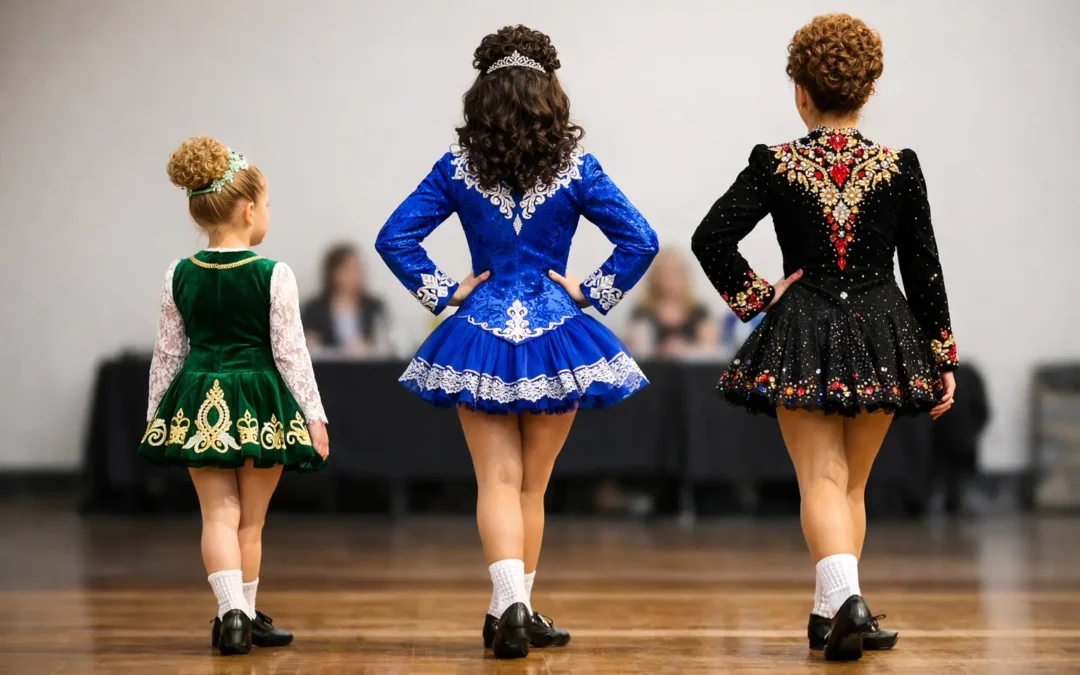
A first feis can feel wonderfully exciting – smart costume, polished shoes, proud family photos – until a parent sees a programme full of age bands, grades and unfamiliar abbreviations. Understanding Irish dance competition age groups takes away much of that uncertainty and helps children arrive feeling prepared, not pressured.
Age groups are there to create fair, enjoyable competition. They allow dancers to perform alongside others at a similar stage of physical development and, usually, a similar amount of life experience. Yet age is only one part of how a competition is organised. A dancer’s grade, the dance they enter and the rules of the particular feis all matter too.
How Irish dance competition age groups work
Most Irish dance competitions group solo dancers by age, often using a cut-off date set by the governing organisation or the individual feis. A programme may show categories such as under 6, under 8, under 10, under 12, under 14, under 16 and over 16. The wording differs, but the principle is the same: dancers compete in the appropriate band for their age on the stated qualifying date.
That qualifying date is the detail to check carefully. It may be the dancer’s age on the day of the competition, at the start of the calendar year, or on another date specified in the entry information. A child who has a birthday shortly before a feis may therefore be placed differently from how a family expects. Always read the competition syllabus rather than relying on how another event arranged its entries.
Some feiseanna use narrower age splits when they have high entry numbers. Others combine age groups where there are fewer dancers. Both approaches can be fair, provided they follow the competition’s published rules. An under-10 section might become separate groups for ages eight, nine and ten at one event, while another may run one combined under-10 competition.
Age is not the same as level
Parents understandably sometimes assume that the youngest dancers will all be beginners, while older dancers will be advanced. In Irish dance, this is not necessarily the case. Competition entries are usually divided by both age and grade.
A young dancer with several years of consistent training may be in a higher grade than an older child who has only recently begun. Equally, a teenager can take their first competition steps in a beginner grade. This is one of the strengths of the system: children and adults can start when it is right for them, without being expected to match the experience of somebody who began much earlier.
Grades can vary between organisations, but commonly reflect progression from beginner-level competitions towards higher championship classes. A dancer moves on because they have achieved the required results, not simply because they have had a birthday. This keeps progress meaningful and gives every dancer clear goals to work towards.
Why competition age bands matter
Irish dance asks a great deal of a dancer. It brings together timing, posture, foot placement, stamina, musicality and performance confidence. In hard shoe, it also requires strength and control to produce clear, precise rhythms. Age bands help make the experience proportionate and encouraging while children develop these skills.
They also help teachers set suitable expectations. A first-time seven-year-old does not need to perform like a child preparing for a major championship. Their achievement may be remembering their steps, smiling at the adjudicator, finding their place on stage and enjoying the applause at the end. Those are valuable milestones.
For older dancers, age categories support a different kind of development. Teenagers may be balancing school commitments, exams, friendships and growing independence alongside training. A well-run competition pathway gives them a focused challenge, a chance to build resilience and an opportunity to see what careful practice can achieve.
Results matter to dancers who are working towards their next grade or championship qualification, but they are not the whole story. Placings can be affected by the size and standard of an entry, the set dance or dance style being judged, and the particular requirements of that day. What lasts longer is the confidence gained from stepping forward and performing.
What parents should check before entering a feis
The syllabus is the most useful document a family will have before entering. It explains the age cut-off, available grades, dances, venue details, closing date and any rules about costume, footwear or music. If anything is unclear, ask your child’s teacher before submitting the entry. It is far easier to clarify a category in advance than to worry about it on the day.
It is also worth checking whether the event is designed for a particular organisation, region or competition level. Some feiseanna are ideal for a dancer’s first solo outing, with a friendly local atmosphere and straightforward classes. Others attract larger, more experienced entries and may suit dancers who are ready for a bigger challenge. Neither is automatically better. The right choice depends on your child’s readiness, goals and enjoyment.
At Kane Irish Dance, competition opportunities are introduced as part of a structured pathway, not as a requirement for every child. Some dancers love the focus of preparing for a feis; others thrive in class, displays, ceilí dancing or performance work. Families should feel able to choose the route that supports their child best.
A quick conversation can prevent unnecessary nerves
Before a first competition, talk through what will happen in simple terms. Explain that dancers may be called by number, perform with other children, wait for results and perhaps receive a medal or certificate. Let your child know that being watched is normal, that nerves are normal too, and that their job is to try their best rather than to win.
Practical preparation helps. Make sure shoes fit comfortably, pack water and a snack, and allow plenty of time for travelling, registration and finding the right stage. Bring layers, particularly for long competition days, and plan for waiting around. Feiseanna can involve early starts and a great deal of cheering, so a calm, organised adult makes a real difference.
When is a child ready to compete?
There is no single age at which a child should enter their first Irish dance competition. Some are ready after a relatively short period of lessons because they enjoy performing and can remember their steps reliably. Others need longer to gain confidence, and that is entirely appropriate.
Readiness is less about perfection than consistency. Can the dancer listen for their music, complete the dance without becoming overwhelmed and recover if they make a small mistake? Do they understand that a competition is a learning experience? Are they interested in taking part rather than feeling pushed into it? A supportive teacher will consider these questions with the family.
For very young dancers, a display or class performance can be an excellent introduction before a formal feis. It gives them the thrill of an audience with familiar support around them. For a nervous older beginner, entering one simple dance in an appropriate grade may feel more manageable than a full day of events.
Supporting healthy ambition at every age
Competition can teach children how to prepare, persevere and respond graciously whether the result is a trophy or a disappointment. Those lessons are most powerful when adults keep the focus on effort. Praise the work behind the performance: the practice after school, the courage to step on stage, the respect shown to fellow dancers and the willingness to return to class ready to improve.
Avoid comparing a child’s result too closely with another dancer’s. Children develop at different rates, and each competitor brings a different level of experience to the stage. A placement may be a brilliant outcome one weekend; on another day, a dancer may learn more from a result that asks them to keep working. Both experiences can build character when they are handled with warmth and perspective.
Irish dance competition age groups provide a useful framework, but they should never become a label for what a dancer can or cannot achieve. With skilled teaching, patient preparation and a community that celebrates progress, each child can find a level of challenge that feels exciting. The best first step is simply to let them enjoy learning the dance well enough to want to share it.