
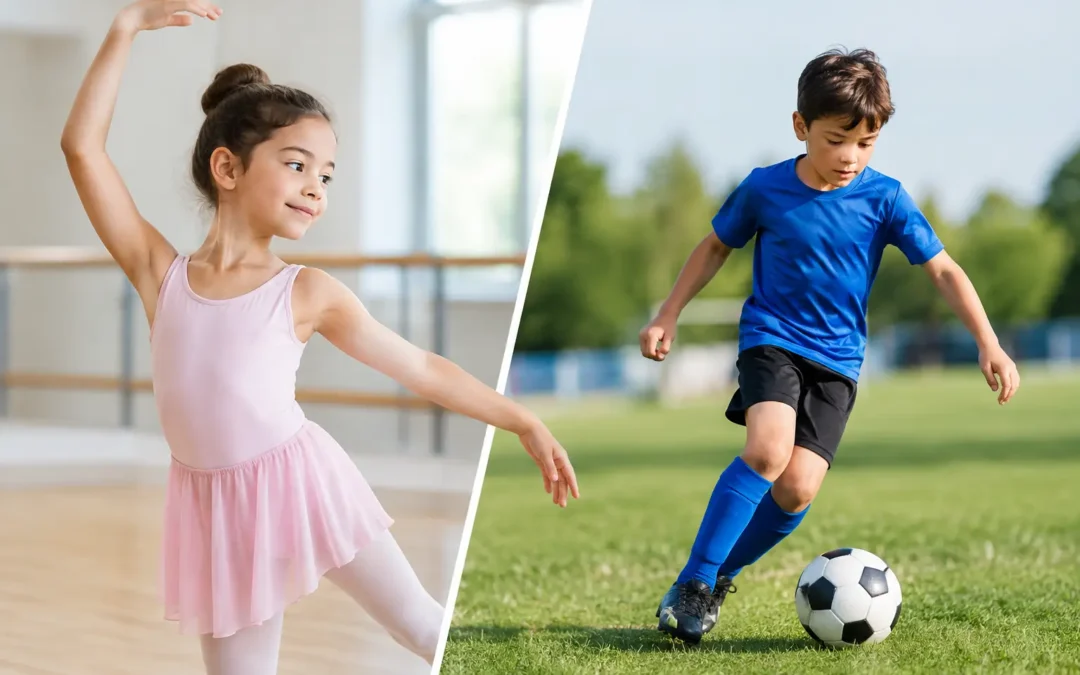
A Saturday morning can make the question feel surprisingly big: dance lessons or football? Both can give a child exercise, friendships and a welcome break from screens. But the best choice is rarely the activity that seems most popular at school. It is the one your child feels excited to return to, week after week.
For many families, football is the obvious first thought. It is familiar, team-based and easy to picture. Dance can feel less familiar, particularly if your child has never stepped into a studio before. Yet Irish dance offers a powerful combination of athletic movement, musicality, individual progress and belonging – with a clear route from a first class to performances and competitive achievement for those who want it.
Dance lessons or football: start with your child
The most useful question is not, “Which activity is better?” It is, “What helps my child feel confident, motivated and themselves?” Children build skills in different ways. Some thrive on chasing a ball, reading a match and working towards a shared result. Others enjoy learning a sequence, hearing their feet become part of the music, and seeing their own effort turn into a new step.
A child who is quiet in a large group may find real confidence in dance. They can be part of a class and a team while still receiving recognition for their personal improvement. A child who has lots of energy may love the fast footwork and stamina involved in Irish dance. Equally, a naturally competitive child can find plenty to aim for through grades, displays, feiseanna and championship pathways.
Try not to choose based only on your own childhood preferences or what siblings enjoy. A football-mad parent can have a child who comes alive in a dance class. A parent who has never danced can discover that their child has found their favourite place to move, make friends and grow.
Fitness looks different in each activity
Football develops cardiovascular fitness, agility, coordination and tactical awareness. It asks children to respond quickly to other players, share space and keep going through a match. For children who love outdoor sport and the buzz of a team game, that can be a brilliant fit.
Dance is also demanding physical activity. Irish dance develops posture, balance, core strength, timing, flexibility, coordination and stamina. Dancers learn to control their bodies precisely, from the lift of the upper body to the speed and clarity of the feet. Soft shoe work and hard shoe rhythms ask for different skills, and both reward practice over time.
There is a practical difference, too. Football sessions can be affected by muddy pitches, cold weather and weekend fixtures. Dance is usually taught indoors in a structured class setting. Neither is automatically better, but this may matter to families balancing travel, younger siblings and busy weekends.
Children do not need to be naturally sporty to begin either activity. The right beginner class should teach foundations carefully, celebrate effort and make movement feel achievable. Progress comes from attendance, encouragement and patient coaching, not from arriving already talented.
Friendship without the pressure to be the loudest
Football friendships often grow through shared teamwork: celebrating goals, learning positions and facing wins or losses together. This can be especially valuable for children who enjoy group energy and do not mind the unpredictable nature of a game.
Dance friendships are built differently. Children learn alongside one another, practise the same steps and encourage each other before a display or competition. There is room for the lively child, the focused child and the child who needs a little longer to settle in. A good class creates a close community without demanding that every dancer be outgoing from day one.
For parents, the atmosphere matters as much as the timetable. Ask how beginners are welcomed, whether children are grouped appropriately by age and experience, and how teachers respond when someone feels nervous. A child is far more likely to stick with an activity when they feel known, safe and valued.
The value of individual progress
One difference between dance lessons and football is how visible individual progress can be. In football, a child may work hard in training but see limited time on the ball during a match. Team selection, positions and match results can all shape how they feel about their contribution.
In dance, every learner has steps, technique and goals to work towards. They may be learning their first reel, improving turnout, remembering a longer routine or preparing to perform. The progress is personal and tangible. A dancer can look back after a term and recognise that they can now do something that once felt difficult.
That does not mean dance is pressure-free. Performing can feel daunting, and competition is not for everyone. However, a well-taught programme allows children to enjoy classes and local displays without needing to compete. Those who do develop an appetite for competition can follow a more ambitious path with expert guidance.
This flexibility is particularly helpful as children grow. A five-year-old may simply enjoy the music and movement. A teenager may want challenge, performance experience, qualifications or the focus that comes with training towards a championship. The activity can grow with them rather than needing to be replaced when their confidence changes.
Consider personality, routine and practical needs
Before committing, think honestly about what will work for your household. Football often brings matches, tournaments and changing fixtures. Dance may involve a regular weekly class, occasional performances and optional events. Neither is a small commitment when a child becomes enthusiastic, but the rhythm can suit families differently.
It is also worth considering how your child handles comparison. Some children are energised by a competitive match. Others become discouraged if they feel they are letting a team down. Dance offers individual standards to work towards within a supportive group, while football centres more directly on collective play and results.
Age can influence the decision, but it should not limit it. Pre-school children often benefit most from playful movement, listening skills and confidence-building. Primary-aged children may enjoy discovering a structured hobby and making friends outside school. Teenagers may be drawn to the discipline, identity and performance opportunities that dance provides. Adults can begin too, even as complete beginners, proving that a new interest does not have an expiry date.
You do not always have to choose
For some children, the best answer to “dance lessons or football?” is both – at least for a while. A weekly dance class and a local football session can complement one another, provided the timetable, cost and rest time remain manageable. Dance can support balance and coordination for football; football can build fitness that helps a dancer maintain energy through a demanding routine.
The warning sign is not doing two activities. It is when a child is constantly rushing, exhausted or unable to enjoy either one. Children need free time as well as organised opportunities. Start with one commitment if that feels right, then add another only when family life can carry it comfortably.
Give a trial class the chance to answer the question
A trial experience is often more revealing than any amount of research. Watch how your child responds when they enter the room. Do they join in? Do they smile when the music begins? Do they talk about a step they learnt on the way home? Nervousness at the start is completely normal, so look for growing comfort rather than instant confidence.
At Kane Irish Dance, beginner dancers are welcomed into a structured, encouraging environment where they can learn at their own stage, make friends and see what Irish dance might become for them. With expert teaching and opportunities ranging from first classes to performance and competition, children can take their next step with purpose.
The right activity will not simply fill an afternoon. It will give your child a place to belong, a reason to practise and the quiet pride of realising, “I can do this.”