
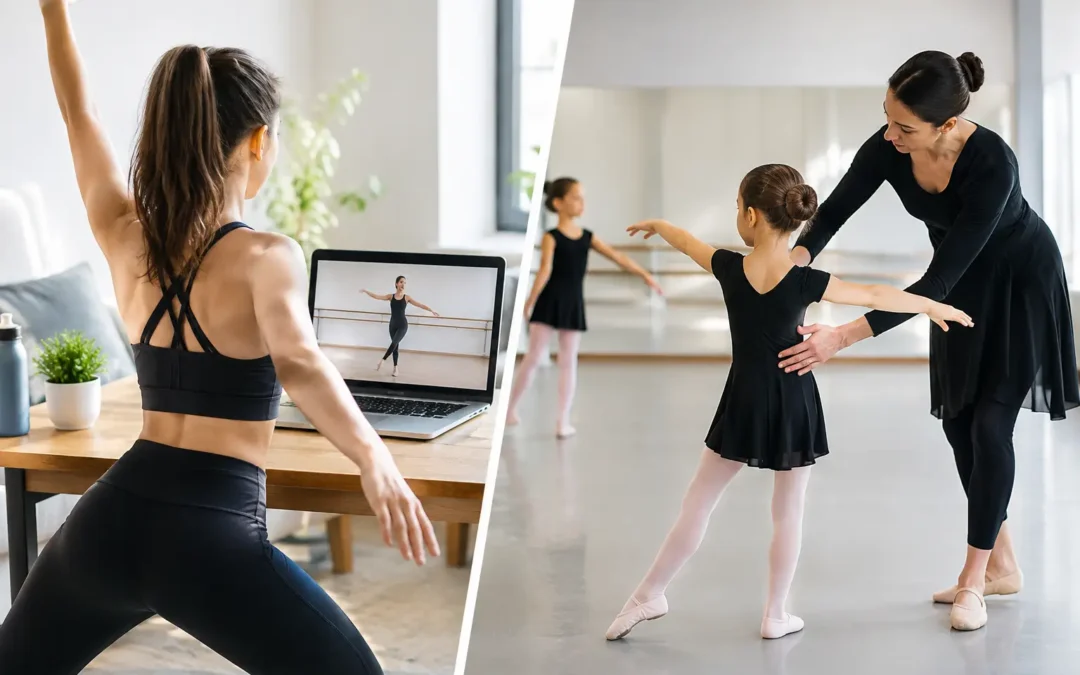
A child has learnt the first few steps of a reel in the living room and cannot wait to show everyone. An adult has finally found an hour in the week that belongs to them. Both are brilliant reasons to begin dancing – but when weighing up online versus in-person dance tuition, the best choice is not always the most obvious one.
Online learning can make Irish dance more accessible and can be a valuable way to practise. In-person classes bring the energy, friendships and detailed teaching that many dancers need to flourish. The right route depends on your dancer’s age, experience, goals and the support available at home.
What in-person dance classes offer
For most beginners, particularly children, learning in a studio provides the strongest foundation. Irish dance is wonderfully energetic, but it is also precise. Posture, turnout, timing, arm placement and weight transfer all matter. A skilled teacher can spot a tiny adjustment before it turns into a habit, then explain it in a way a dancer understands.
That immediate feedback is difficult to replicate through a screen. In class, a teacher can demonstrate from different angles, work with a dancer one-to-one and break a movement into manageable stages. Young dancers also learn by watching their peers. Seeing another child try, improve and celebrate their progress makes the learning process feel normal rather than daunting.
The studio environment brings something else that matters just as much: belonging. Children arrive, greet friends, take their place in the line and work towards a shared goal. For a shy child, this routine can steadily build confidence. For a lively child, it provides positive structure, focus and a place to put their energy.
Space to move with confidence
Irish dance needs room. Whether a dancer is practising a light jig, beginning hard-shoe rhythms or learning a ceilí sequence, a suitable floor and enough space make a real difference. An in-person class gives dancers the freedom to travel, turn and practise safely without worrying about furniture, pets or a slippery kitchen floor.
It also gives families reassurance. A well-run academy has clear safeguarding practices, appropriate supervision and teachers who understand how to progress dancers at the right pace. At Kane Irish Dance, that means an inclusive setting led by experienced teachers, where beginners are welcomed and ambitious dancers can work towards performances, competitions and championship goals.
Motivation that grows from friendship
Not every dancer is motivated by the same thing. Some love earning the next step. Others want to perform in front of an audience, take part in a holiday club or laugh their way through a ceilí with friends. In-person tuition brings these motivations together.
When dancers hear the music start and feel a class moving in time, they experience Irish dance as a shared activity rather than a task to complete alone. That sense of occasion helps attendance become a happy weekly habit. It can be especially valuable for teenagers, who often stay involved because dance gives them friendship, achievement and a positive identity outside school.
Where online dance tuition works well
Online dance tuition is not a lesser option by default. It can be a thoughtful, practical solution for some families and adult learners. It removes travel time, can fit around busy schedules and allows dancers to revisit explanations in a familiar setting.
For adults who feel nervous about trying dance for the first time, an online session may be a gentler first step. There is no concern about walking into a room where everyone appears more experienced. They can focus on the music, learn the basics at their own pace and build enough confidence to join a class later.
Online tuition can also support dancers who already attend classes. A short practice session between lessons can help them remember choreography, listen more closely to a piece of music or repeat a technical exercise. Used this way, online learning extends the work of the studio rather than replacing it.
The practical benefits for busy families
A live online lesson can be helpful when travel is difficult, a family diary is unusually full or a dancer is temporarily unable to attend their usual class. It gives continuity, particularly when a child is keen not to lose momentum.
Recorded guidance can be useful too, provided it is clear and age-appropriate. Being able to pause a demonstration and repeat a short sequence can help a dancer who needs a little longer to process a new step. Parents may also gain a better understanding of what their child is learning.
However, flexibility only works when the home set-up supports it. A reliable internet connection, a safe practice area and an adult nearby for younger children are all important. It is also worth being realistic: a tired child may find it harder to concentrate in the room where they usually relax, play or watch television.
Online versus in-person dance tuition: key trade-offs
The decision is rarely about whether one format is good and the other is bad. It is about matching the format to what will help a dancer make progress and enjoy the journey.
In-person tuition is usually the better choice when a dancer is very young, completely new to Irish dance, working on technical development or preparing for a display or competition. These are the moments when hands-on correction, group spacing, musical timing and teacher observation have the greatest value. A beginner also benefits from learning class etiquette, taking turns and developing the confidence to perform alongside others.
Online tuition may suit an adult beginner looking for a low-pressure introduction, a dancer who needs occasional supplementary practice, or a family with a short-term barrier to attending in person. It can be effective when lessons are interactive, the teacher can see the dancer clearly and goals are simple and specific.
For dancers with performance or competition ambitions, regular studio training is particularly important. A teacher needs to assess technique over time, prepare dancers for the realities of performing in a group and develop the resilience that comes from practising, receiving feedback and trying again. Progress is not only about memorising steps. It is about musicality, presentation, fitness, discipline and the ability to dance with confidence when it counts.
Choosing the right start for your dancer
Begin with the question: what does your child, teenager or adult learner need most right now? If the answer is friendship, movement, careful guidance and a weekly routine, an in-person trial class is likely to be the most rewarding place to start. It lets a dancer feel the atmosphere for themselves rather than trying to imagine it from home.
If confidence is the main barrier, look for a beginner-focused class where nobody is expected to arrive knowing the steps. The quality of the welcome matters. A good teacher celebrates effort, gives clear corrections and creates a culture where dancers can make mistakes without embarrassment.
For parents, it can help to ask practical questions before committing: Is the group right for my child’s age and stage? Is there a clear progression route? Are there opportunities to perform if they enjoy it? Can they try a class before enrolling? These details make a big difference to whether dance becomes a short-lived activity or a lasting source of confidence and achievement.
Adults should give themselves the same permission to begin as children. You do not need to be naturally flexible, have danced before or arrive with a friend. A supportive beginner course should make the first class feel achievable, enjoyable and full of possibility.
The best next step is often a simple one: book a trial, meet the teacher and let the music do the persuading. The right dance class should leave every learner feeling they have found room to grow.