
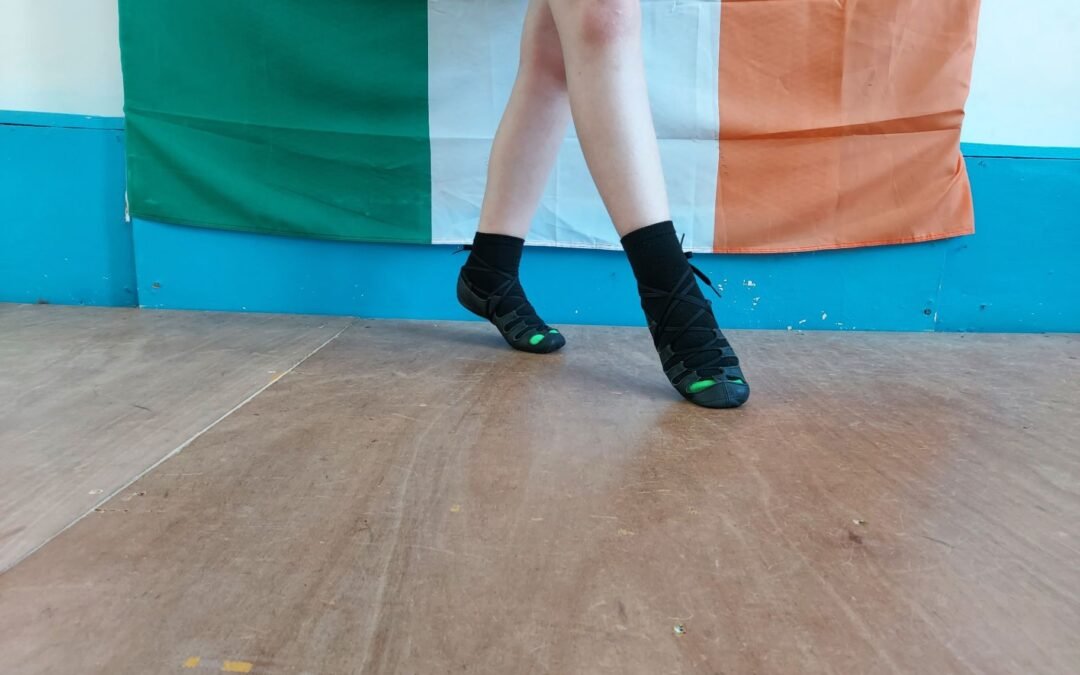
Some Irish dances leave room for schools and teachers to create their own steps. The traditional sets are different: each has a particular tune and a fixed sequence of steps, passed on from dancer to dancer. That gives them a special place in traditional Irish dance, and makes them a wonderful way for children to connect with a tradition that reaches far beyond the studio.
What makes a traditional set dance?
A traditional set is a solo hard-shoe dance with choreography that stays the same. Wherever a dancer learns the recognised version, the steps follow the same pattern. By contrast, for many jigs and reels, each school or teacher may teach their own choreography.
Kane Irish Dance is registered with Cumann Rince Dea Mheasa (CRN), which recognises nine traditional sets:
- St Patrick’s Day
- The Blackbird
- Job of Journeywork
- Garden of Daisies
- Three Sea Captains
- King of the Fairies
- Jockey to the Fair
- White Blanket
- The Hunt
These dances are distinctive not because they need to change, but because their familiar steps have endured. Each set gives dancers a shared reference point, connecting a lesson in Huddersfield with a tradition carried across generations.
When the tune and dance belong together
Traditional set tunes have an unusual musical shape. Much Irish dance music is built in neat eight-bar parts, but these tunes may be “crooked”: their phrases are irregular and don’t fit that tidy pattern.
Instead of making the dance fit a standard musical structure, the steps and tune belong to one another. The choreography follows the distinctive phrasing, and the music is performed with its particular dance. You can’t simply swap in another tune and expect the set to work.
That close relationship is part of the magic. A dancer learns to recognise the musical landmarks and answer them with precise steps. The tune becomes more than a backing track; it is a partner in the performance.

A tradition carried across generations
The roots of these particular dances reach back to the 18th-century dancing masters, who set down and taught dances that became known by name. Their work helped preserve specific combinations of music and movement. You can read more about their role in our post on the dance masters who taught across the Irish countryside.
As Irish dancers emigrated, they carried the sets with them. Today, a dancer may meet the same recognised St Patrick’s Day set in Huddersfield, Boston or Kerry. That shared choreography is a striking reminder that tradition can travel while keeping its shape.
It is living heritage, not a museum piece. Every time a pupil practises the steps, the dance is being learned anew, while remaining connected to all the dancers who came before.
St Patrick’s Day: a first set to remember
For many dancers, St Patrick’s Day is the first traditional set they learn. It is a lovely introduction for children because the tune gives them clear musical landmarks. As they become familiar with its phrases, they can hear where they are and anticipate what comes next.
That moment when a child recognises the music and confidently moves into the next part is a joy to see. Rebecca, Kane Irish Dance’s owner and a World Champion, teaches these sets in the studio using the same steps she learned. The fixed choreography gives pupils a clear sequence to practise and a strong sense of achievement as it begins to feel natural.

Why fixed steps matter to families
For parents, a set dance offers more than a fascinating piece of Irish tradition. Because the steps are defined, children have a clear goal to work towards and can see their progress over time. They can practise the same choreography, prepare for grades and medals, and take part in feiseanna, the Irish dance competitions where they perform and celebrate their progress.
At Kane Irish Dance, CRN grades and awards give pupils milestones to aim for. Some children love the focus of working towards a new badge; others are excited by the chance to compete. Either way, the set provides a meaningful challenge and a shared standard.
And beyond the steps, there is a deeper reward: belonging to something much older than any one class. For parents on the lookout for Irish cultural activities with real substance behind them, these dances connect young pupils with music, movement and a heritage carried across generations. If you’d like to explore more, our beginner’s guide to traditional Irish dance is a friendly place to start.

Come and discover the old sets
The nine traditional sets show how a dance can remain constant and still feel exciting every time it is performed. Their fixed steps, unmistakable tunes and far-reaching history make them a wonderful part of Irish dance, and a rewarding challenge for young dancers to take on.
If your child would like to learn Irish dance and discover these sets, Kane Irish Dance in Huddersfield would love to welcome them. Book a free, no-obligation 15-minute induction for new children with Stephanie, our secretary for induction bookings, on 01484 958726.