
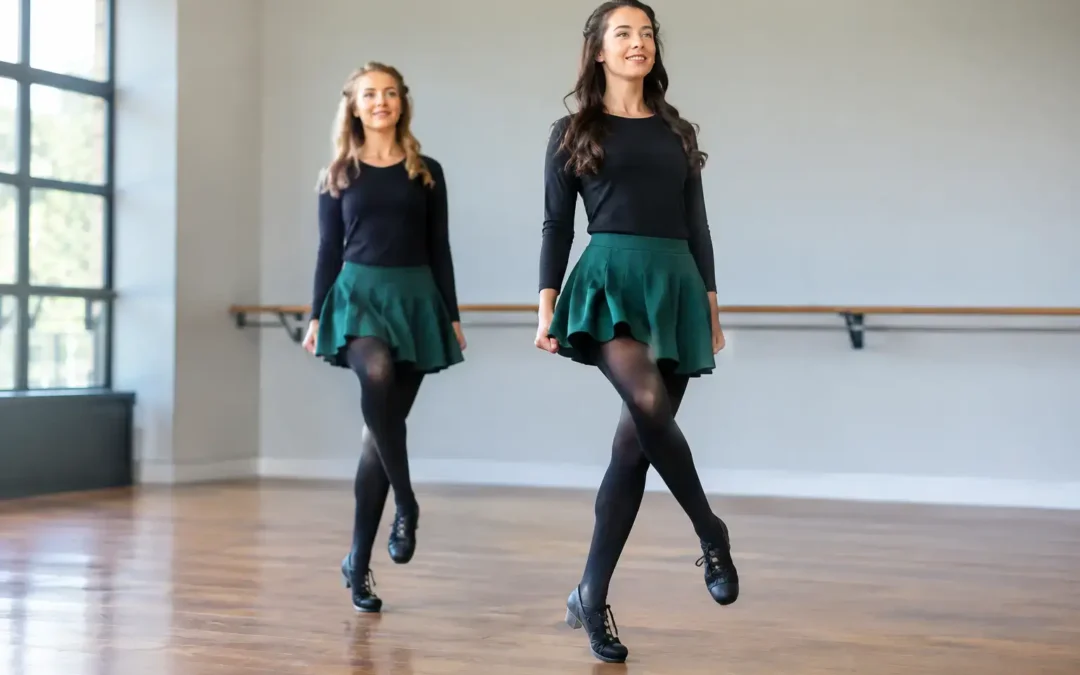
A dancer can know every step and still feel a little behind the music. That is why learning to improve Irish dance timing is not simply about counting louder. It is about building the listening skills, body control and confidence that allow steps to look sharp, sound musical and feel enjoyable.
For young dancers, timing can take time to settle because there is so much to remember at once: feet, arms, posture, turns, skips and the excitement of dancing with friends. For adults beginning later in life, the challenge is often trusting the rhythm rather than overthinking every movement. Both need patient, purposeful practice and teaching that makes the music feel approachable.
What good timing sounds and looks like
In Irish dance, timing means placing each movement exactly where it belongs in the music. It is not always about moving as quickly as possible. A dancer with strong timing can keep a steady beat, start and finish phrases clearly, and adjust their steps to suit the pace of the reel, jig, slip jig or hornpipe.
Good timing is easy to spot in a class or performance. The dancer is not rushing ahead of the music or trailing behind it. Their feet create a clean rhythm rather than a hurried series of sounds. Even when a step is challenging, the movement has a sense of control.
This matters for far more than competitions. Timing helps dancers feel secure in group routines, makes ceilí dancing more sociable, and gives a performance its energy. It also builds a useful life skill: listening carefully, responding calmly and staying focused when there is a lot happening around you.
Improve Irish dance timing by listening first
Many dancers try to fix timing by repeating a difficult step again and again. Repetition has a place, but it is much more effective when the dancer understands what they are listening for.
Start by listening to the tune without dancing. Clap or tap the pulse with one hand on your knee. Keep it simple at first. The goal is not to show every sound in the music, but to find the steady beat that sits underneath it. Once that beat feels reliable, listen for where the tune repeats and where a new phrase begins.
For children, it can help to make this playful. Ask them to march around the room, clap the beat, or tap it on the floor before putting on dance shoes. A parent does not need an Irish dance background to support this. If your child can keep a steady pulse while listening, they are already developing an essential part of their dancing.
Adults may find that listening away from class removes some pressure. Put on a short piece of suitable Irish dance music while making a cup of tea or travelling to work, then tap the beat gently. Familiarity makes it easier to return to class and recognise the rhythm before the first step begins.
Count the structure, not every foot
Counting is valuable, particularly when learning a new routine, but it can become unhelpful if dancers are trying to count every single movement in their head. This often causes tension and makes the body react late.
Instead, use counts to understand the shape of the step. Notice where the step starts, where the major changes happen, and where it finishes. A teacher may use spoken cues, clapping or simple counts to establish this structure. Once it is familiar, the music should gradually take over.
If a dancer loses their place, encourage them to rejoin at the next clear musical phrase rather than stopping in frustration. This is a valuable performance habit. In a display, class routine or competition, being able to recover calmly is often more useful than trying to make every practice run perfect.
Slow practice creates faster progress
One of the most common timing problems is rushing. Dancers rush when they are excited, nervous, trying to keep up with someone else, or attempting a speed they have not yet earned.
Practising slowly is not a sign that a dancer is behind. It is how the body learns the correct order and rhythm of a movement. Start without music if needed, using clear verbal counts. Then add music at a comfortable pace. Only increase the speed when the dancer can stay relaxed, accurate and in time.
This is especially helpful for hard shoe work. Strong sounds come from placing the foot with control, not stamping as hard as possible. When a dancer forces the sound, they may lose both rhythm and balance. Clean, well-timed sounds at a slower pace will develop into better rhythm at full speed.
A short practice with a clear aim is usually better than a long practice where concentration fades. Ten focused minutes might include walking the rhythm, practising one troublesome section slowly, then dancing the complete step once with the music. Finish with something that feels achievable, so practice remains a positive part of the week.
Posture and balance affect rhythm
Timing is not only heard through the feet. It begins with the whole body. If a dancer is leaning, looking down, gripping their shoulders or losing balance through a turn, the feet must work harder to catch up. That can make a step appear rushed even when the dancer understands the music.
Encourage a tall, calm posture with the head lifted and core engaged. In Irish dance, controlled upper body position gives the legs a dependable base from which to move. This does not mean dancers should become stiff. The aim is poised and ready, with enough strength to hold their shape as the feet work quickly.
For younger children, simple imagery can help: imagine a string gently lifting the top of the head, or balance a pretend crown without letting it fall. For teens and adults, it can be useful to film a short practice clip and watch it back with a specific question: did my posture stay steady when the timing slipped? Looking for one pattern at a time is more constructive than criticising every detail.
Practise in smaller sections
A full dance can feel overwhelming when one section is causing difficulty. Break the step into manageable pieces, perhaps four or eight bars at a time, depending on the routine. Work on the transition into and out of the difficult part, not only the part itself.
This approach teaches dancers how the sections connect. Often, a timing error begins one or two movements earlier than expected. Perhaps the lead foot was late, a turn travelled too far, or a hop did not have enough lift. By slowing down the lead-in, the cause becomes clearer.
When practising at home, leave enough room to move safely and use the footwear recommended by your teacher. Hard shoe sounds should not be practised on a surface that could cause damage or slipping. If full dancing is not practical, mark the movements lightly or practise the rhythm by tapping with the feet while seated. The musical learning still counts.
Learn alongside, not against, other dancers
In group classes, dancers naturally look at those around them. This can be helpful when learning formations or shared routines, but it can also lead to copying someone else’s pace instead of listening to the music.
Teach dancers to use the group as support, not as a metronome. The music and the teacher’s instruction come first. In time, dancing together becomes one of the best ways to strengthen rhythm because the group learns to start, finish and move as one.
Parents can support this by praising effort that is not based on comparison. Comments such as, “I could see you kept going with the music,” or, “Your sounds were really clear today,” help children notice progress without measuring themselves against a friend. Confidence and timing grow well together.
When timing problems need extra support
Every dancer has an occasional off day. Tiredness, a growth spurt, new shoes, nerves before a performance or a more demanding routine can all affect rhythm. A temporary wobble does not mean a dancer lacks ability.
However, if the same issue continues over several weeks, speak with the teacher. An experienced Irish dance teacher can identify whether the challenge is musical understanding, foot placement, balance, fitness or simply a step that needs breaking down differently. The best solution depends on the dancer. Some need a slower track; others need clearer counts, more listening practice or a little reassurance.
At Kane Irish Dance, timing is developed as part of a wider journey in confidence, musicality and technique. Dancers are supported from their first beginner steps through to performances and competitive goals, with progress built carefully rather than rushed.
The most encouraging thing about timing is that it can improve at every age and stage. Listen closely, work in small sections, allow time for slow practice, and celebrate the moments when the music and movement begin to click. Those moments soon become the rhythm a dancer can rely on.