
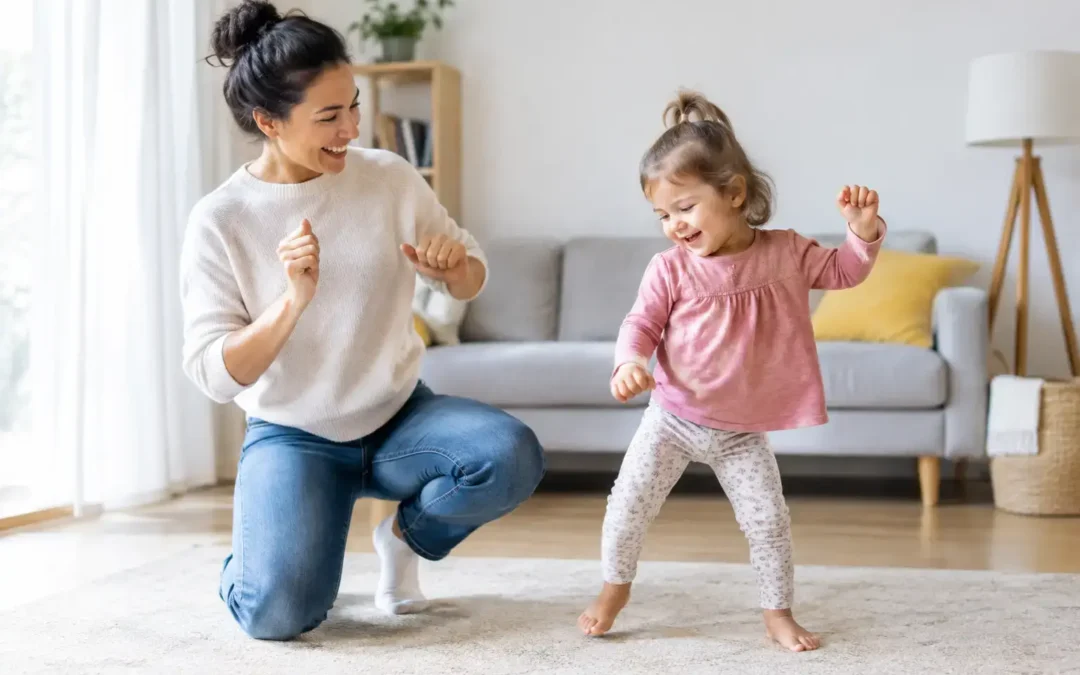
A toddler who stamps the instant a favourite song begins is already showing the beginnings of musical understanding. To teach toddler dance rhythm, you do not need formal drills, perfect timing or long practice sessions. You need a clear beat, a little repetition and the freedom for your child to respond with their whole body.
At pre-school age, rhythm is learned through experience. Children feel it in clapping hands, bouncing knees, marching feet and the exciting pause before the music starts again. Those small moments build listening skills, coordination and confidence – all valuable foundations for dance, school and everyday play.
What rhythm means for toddlers
Rhythm is the steady pulse underneath music. For a young child, it is less about counting in sets of eight and more about recognising, “I can move when I hear this beat.” If they can clap along for a few seconds, march to a song or copy your tap-tap-pause pattern, they are learning rhythm.
Toddlers will not keep a beat consistently at first. They may rush when they are excited, stop to watch something else or invent their own moves halfway through. That is completely normal. Their attention, balance and ability to control their movements are still developing, so the goal is participation rather than precision.
A positive response matters more than a correction. Instead of saying, “You are too fast,” try, “Can you make your feet match my slow claps?” It turns a mistake into a game and keeps dancing associated with success.
How to teach toddler dance rhythm through play
The most effective rhythm activities are short, predictable and cheerful. Five focused minutes can be far more useful than asking a toddler to repeat an exercise until they lose interest. Choose a time when they are rested and willing to move, rather than trying just before a meal or when they are overtired.
Begin with a steady beat
Start without music. Sit or stand facing your child and clap a slow, even pulse: clap, clap, clap, clap. Invite them to copy you. If clapping is tricky, pat your knees together, tap the floor or march on the spot instead.
Keep the beat noticeably slow at first. Adults often choose a pace that feels natural to them, but toddlers need enough time to hear the sound, process it and make a movement. Once they can join in, change the volume rather than the speed: try quiet taps, then big loud claps. This helps them listen closely while staying on the same pulse.
When you add music, pick songs with a strong, uncomplicated beat. Marching music and lively traditional tunes work particularly well because the pulse is easy to hear. There is no need for a large playlist. Using the same few songs for a fortnight gives your child the reassurance of familiarity and lets them notice more each time.
Use movement words they can understand
Toddlers respond best to images and actions, not technical dance instructions. Ask them to make “giant steps” for a slow beat, then “mouse steps” for a quiet one. You can pretend to be a train, with each footstep landing as the wheels go around, or a bouncing ball that drops on every clap.
For early Irish dance movement, simple marching is a wonderful place to begin. Encourage tall bodies, arms relaxed by their sides and feet taking turns. The posture does not need to look polished. You are helping them connect a sound to a step, while also developing body awareness in a way that feels achievable.
Give one instruction at a time. “March with me” is enough. Adding arms, turns and a new direction all at once can make a toddler feel as though they have failed before they have had a chance to enjoy it.
Play copycat, then let them lead
Copying games develop both rhythm and concentration. Make a simple pattern such as clap-clap-pat, then wait for your child to have a turn. Begin with two sounds before progressing to three. If they copy only part of it, celebrate the effort and repeat the pattern with them.
Then reverse the roles. Let your child create a pattern and copy it as closely as you can. They will often find this hilarious, but it also shows them that their ideas matter. Children who feel listened to are more likely to try again when an activity becomes challenging.
Try these four quick games across the week:
- Freeze and go: March to the beat, then freeze when the music stops. Start again as soon as it returns.
- Tap the animal: Make a slow elephant stomp, a light bird tap or a bouncy rabbit hop to a steady pulse.
- Pass the clap: Take turns adding one clap each without rushing. Keep it playful if the pattern falls apart.
- Scarf beat: Wave a scarf up on one beat and down on the next, matching your movement to the music.
These games encourage control as well as energy. A child who learns to stop, wait and restart is building the listening habits that make later dance steps easier to learn.
Let repetition do its work
Adults can worry that repeating one activity is boring. For toddlers, repetition is often where confidence grows. The first time they hear a song, they may simply listen. The third time, they might march. By the sixth time, they may anticipate the pause and beam when they freeze at exactly the right moment.
Keep a tiny rhythm routine at home. A familiar song after breakfast, two minutes of clapping before bath time or a marching game while waiting for dinner can all work. The best routine is the one that fits your family life and does not become another chore.
When your child seems out of time
Some toddlers naturally find a beat quickly; others need longer. Being out of time at two, three or four years old does not mean a child lacks musical ability. They may be concentrating on balance, trying to remember the action or feeling shy about being watched.
Make the task easier before making it harder. Reduce a fast song to knee pats. Hold hands while you march together. Stand beside them rather than in front of them if copying feels difficult. A child may also engage more readily with a prop, a favourite character game or music they have chosen themselves.
It depends on the child’s temperament, too. An energetic child may need bigger movements before they can settle into controlled steps. A cautious child may prefer watching for several sessions before joining in. Both approaches can lead to real progress when they are met with patience.
Avoid comparing siblings or friends. Rhythm develops at different speeds, and confidence can disappear quickly when a child believes they are the one who cannot keep up. Notice specific wins instead: “You heard the stop,” “Your feet matched the claps,” or “You remembered the pattern.”
From home rhythms to a dance class
Home play creates a lovely starting point, but a well-led pre-school class brings extra benefits. Children learn to follow a teacher, take turns, move alongside others and enjoy music as part of a welcoming group. They also see that everybody is learning, which can be especially reassuring for a child who is hesitant at first.
At Kane Irish Dance, pre-school dancers are introduced to rhythm through imaginative, age-appropriate activities that make movement feel fun while gently building the foundations for future Irish dance. The focus is never on expecting tiny children to perform like older dancers. It is on helping them feel capable, included and proud of what their bodies can do.
A class can be particularly helpful when your child loves music but is easily distracted at home, or when you would like guidance on what comes next. An experienced teacher can adjust an activity in the moment, offer encouragement that suits the child and create a calm structure around all that wonderful toddler energy.
Keep the joy bigger than the goal
Rhythm is not a test your child needs to pass before they can dance. It is a skill that grows through hundreds of happy moments: a stomp in the hallway, a clap in the kitchen, a giggle during a freeze game and a proud little bow at the end of a song.
Follow their interest, keep sessions brief and let progress be delightfully uneven. When a toddler learns that music is a place where they can move, belong and be celebrated, the beat will have every chance to find its way into their feet.