
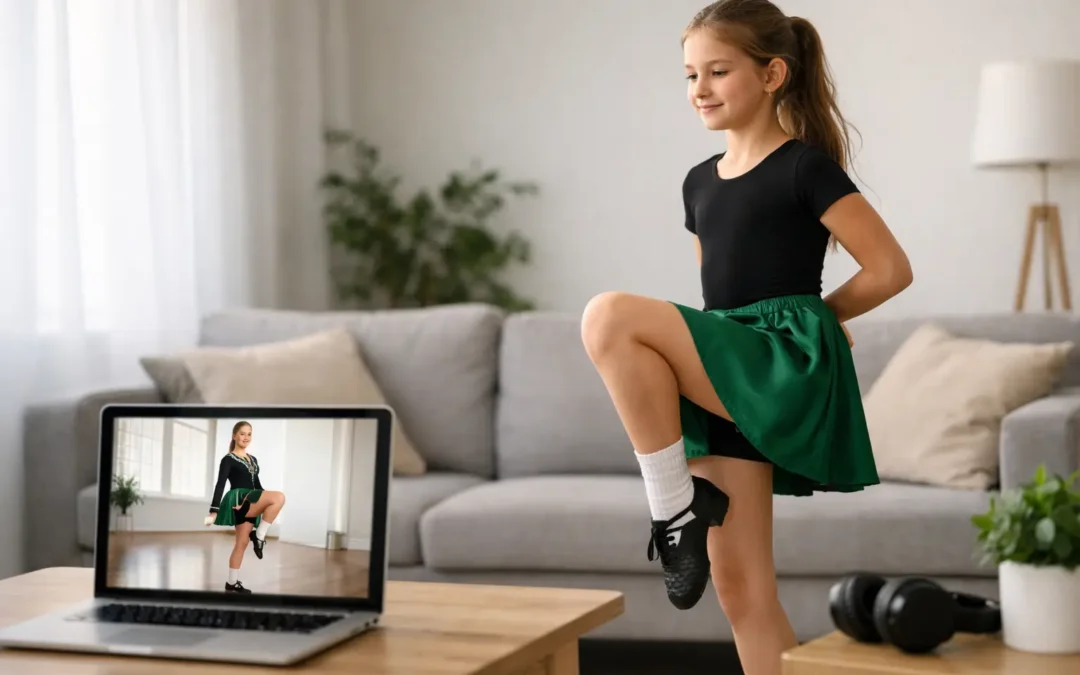
A child who has spent the afternoon practising a new reel step in the kitchen is not simply learning footwork. They are listening closely, trying again when a rhythm feels tricky, and feeling proud when it finally clicks. That is the real value of online Irish dance lessons: they can bring purposeful, joyful learning into family life, without asking a complete beginner to feel confident before they have had the chance to begin.
For children, teenagers and adults, learning online can be a welcoming first step into Irish dance. It gives dancers time to become familiar with the music, vocabulary and basic positions in a setting that feels comfortable. With expert guidance and a clear structure, home learning can build the confidence that helps a dancer walk into a class, a performance or their first competition with their head held high.
What online Irish dance lessons can offer
Irish dance is known for its energy, precision and unmistakable music, but no one starts with perfect turnout or fast footwork. Every dancer begins by learning how to stand tall, hear the beat and move with control. Online teaching can make those early stages feel more manageable, particularly for families balancing school, clubs and busy weekday routines.
A well-planned lesson gives learners more than a video to copy. It should break movements into achievable sections, explain what good technique feels like, and leave time to repeat the work. Rather than rushing towards a full routine, dancers learn the habits that make progress possible: pointed toes, strong posture, soft knees, accurate timing and focused listening.
For parents, this can be reassuring. You do not need Irish dance experience to encourage your child. A small, clear practice space, comfortable clothing and a willingness to celebrate effort are enough to get started. The important part is that the dancer feels supported rather than judged.
A strong start for young dancers
For pre-school children and younger primary-aged dancers, online learning works best when it feels playful, active and short enough to hold their attention. Children may begin with rhythm games, simple skips, balance work and movements that develop coordination. These foundations matter. They prepare young dancers for more detailed technique while helping them associate dance with enjoyment, friendship and achievement.
As children grow, they can work towards beginner soft shoe steps, basic reels and jigs, and the confidence to remember a sequence independently. Learning at home also gives them a chance to revisit a section without the pressure of keeping up with a whole room. Some children need to see a movement several times before it settles, while others enjoy the challenge of practising a little each day.
That said, every child is different. A confident mover may be ready for more detailed choreography, whereas a quieter beginner may benefit from a slower pace and plenty of encouragement. Good teaching meets the dancer where they are, then gives them a positive next goal to reach for.
Confidence is part of the lesson
The benefits are not limited to dance technique. Learning a new step asks children to concentrate, respond to feedback and keep going through mistakes. Those are valuable skills in school, sport and everyday life.
When a child can say, “I could not do that last week, but I can do it now,” they have achieved something far more lasting than one sequence of steps. They have learnt that progress comes from patience and practice. For many families, this growing confidence is one of the most rewarding parts of Irish dance.
Online Irish dance lessons for teenagers and adults
Teenagers can sometimes feel nervous about trying a new activity, especially if they believe everyone else will already know what they are doing. Online lessons can take away some of that initial worry. They offer a private space to learn the basics, improve fitness and reconnect with music and movement before joining a group setting.
For adults, the same principle applies. Irish dance is not reserved for people who started at five years old. Adult beginners often join because they enjoyed Irish music, watched a show, want a sociable new hobby or simply fancy moving more. The first lesson should feel encouraging, not intimidating.
Adults may need a little more attention to warm-ups, mobility and pacing, particularly after a long day at work or if they are returning to exercise. There is no prize for forcing a movement that does not feel right. Steady progress, good alignment and enjoyment will take a dancer much further than trying to do everything at full speed on day one.
Online learning can be particularly useful for revisiting class material between sessions. A dancer can practise a section, notice where they lose the beat, and return to their teacher with a more specific question. This turns practice into an active part of learning rather than a guess at what happened in class.
Creating a safe space to practise at home
Irish dance is lively, so the environment matters. Dancers need enough clear floor space to take a few steps safely, away from furniture, pets and trailing cables. A non-slip surface is best, and beginners should avoid practising high-impact movements on hard flooring for long periods without appropriate advice.
Soft shoes are often suitable for early technique work, but footwear will depend on the lesson and the dancer’s stage of development. Hard shoe work brings a wonderful percussive sound, yet it also requires careful instruction, suitable flooring and consideration for neighbours. It is sensible to build control in soft shoes before concentrating on louder, more advanced rhythms.
A short warm-up should always come first. Ankles, calves and hips work hard in Irish dance, and young dancers in particular can be tempted to start at full energy the moment the music begins. A teacher-led warm-up helps prepare the body and teaches dancers that looking after themselves is part of being disciplined and capable.
Parents do not need to supervise every step, but younger children benefit from having an adult nearby. A quick check that the space is clear and the dancer is following the lesson safely makes home practice more relaxed for everyone.
When online learning works best
Online tuition is especially valuable when it is part of a clear learning journey. It can introduce a complete beginner to Irish dance, support regular practice between classes, help a dancer prepare for a performance, or keep momentum going during holidays and busy family periods.
There are trade-offs, of course. A screen cannot fully recreate the excitement of dancing in a group, making friends at class or receiving immediate in-person corrections from a teacher. Partner work, ceilí dancing and performance skills are also easier to develop in a shared studio space. For dancers who hope to compete, in-person coaching becomes increasingly important as technique, stamina and presentation develop.
The strongest approach is often a blend. Online learning gives dancers flexibility and repetition; face-to-face classes bring community, detailed feedback and the wonderful feeling of dancing together. At Kane Irish Dance, that combination supports a clear route from a first trial through to displays, competitions and championship ambitions.
Making practice a positive family habit
Practice does not need to take over the house. Ten focused minutes can be far more useful than an hour of distracted repetition. Choose a regular time, keep the goal simple and finish on something the dancer can do well. This helps children leave practice feeling successful and ready to return next time.
It also helps to praise specific effort. Instead of only saying “well done”, notice the detail: “You kept the beat all the way through,” or “Your posture looked really strong today.” Specific encouragement teaches dancers what they are improving and shows them that their hard work is being seen.
For adults, a realistic routine matters just as much. Put on the music, clear a little space and allow yourself to be a beginner. The joy of Irish dance is not found in getting every step right immediately. It is found in the lift of the tune, the satisfaction of steady improvement and the welcome that comes from being part of something positive.
The best first step is a simple one: make room to try. Whether your goal is a child’s first reel, a teenager’s new challenge or an adult’s long-awaited hobby, expert teaching and a little regular practice can turn curiosity into real confidence.