
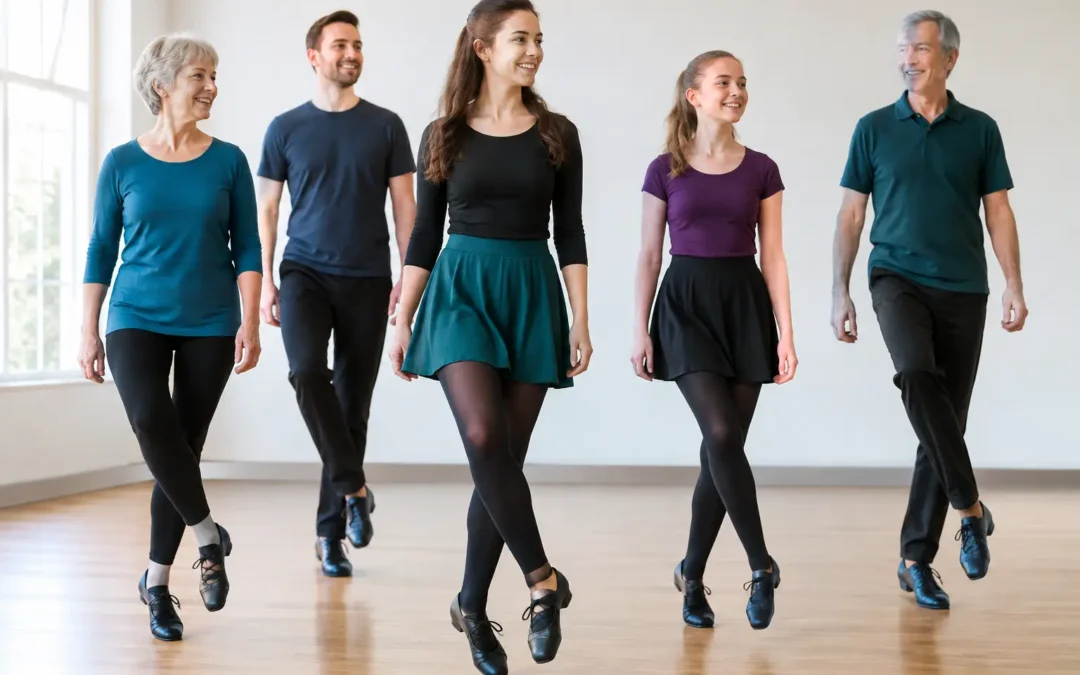
A ceilí begins with a room full of people moving together, not a row of dancers trying to get every foot perfectly right. When you learn ceilí dance steps, you are learning a sociable form of Irish dance built on music, rhythm, teamwork and plenty of encouragement. That makes it a wonderful starting point for children, teenagers and adults who want to be active, meet people and enjoy Irish culture without feeling they need previous dance experience.
Unlike a solo routine, ceilí dancing asks you to notice the people around you. You may dance in a circle, a line, a square or a long set, changing partners as the music carries the group through the pattern. The steps matter, but so do the smiles, the shared timing and the willingness to have another go when everyone turns the wrong way at once.
What are ceilí dance steps?
Ceilí dancing is traditional Irish social dancing. The word “ceilí” refers to a social gathering, and the dances were designed to bring people together. Some are light and lively, with easy travelling movements; others have more detailed figures that reward concentration and practice.
The music is usually played in a jig, reel, hornpipe or polka rhythm. You do not need to identify every tune before you start. A good teacher will help you hear the beat, count the phrase and recognise when the next movement is coming. For beginners, the aim is not to race ahead. It is to move safely and confidently in time with the group.
At Kane Irish Dance, ceilí is taught as a welcoming social activity as well as a valuable foundation for broader Irish dance development. Children learn awareness, rhythm and respectful partnering. Adults rediscover the pleasure of learning something new in a room where nobody is expected to arrive knowing the steps.
Learn ceilí dance steps by starting with the rhythm
Before thinking about complicated formations, let your feet become familiar with the music. Most beginner ceilí movements are based on walking, skipping, hopping and simple step patterns. The difference lies in how clearly you place each movement on the beat.
Stand tall with your shoulders relaxed and your weight balanced through both feet. Irish dance has a proud, lifted quality, but that should never mean stiff or tense. Keep your knees soft enough to move easily and let your arms rest naturally unless the dance requires you to hold hands with a partner or group.
A teacher may count you in with phrases such as “one, two, three, four” or ask you to listen for an eight-count. This is useful because ceilí dances are organised in musical phrases. If you understand where a phrase begins and ends, the next instruction feels far less sudden.
It is normal for beginners to watch their feet at first. Try to lift your gaze whenever you can. Looking up helps your posture, lets you see where your group is travelling and makes partnering more comfortable. In a social dance, awareness is as useful as footwork.
Four movements you may meet first
The exact steps vary between dances and teaching traditions, but these four ideas appear again and again:
- The skip step is a light travelling movement, often used when moving around the room or towards another couple. Think of a gentle step-hop rhythm rather than a large leap.
- The sevens travel sideways in a counted pattern, commonly finishing with a small hop or lift. They help dancers move neatly across a set without losing the beat.
- The rising step adds a buoyant, up-and-down feeling. It is often introduced once dancers are comfortable with basic timing and balance.
- Turning and changing places are central to ceilí. These movements teach dancers to travel with purpose, make eye contact and leave enough room for everyone.
Do not worry if these names feel unfamiliar on your first lesson. Dance vocabulary becomes meaningful once your body has experienced it. A patient class will repeat each movement slowly, then build it into the dance when the group is ready.
The real skill: dancing with other people
A ceilí can look wonderfully energetic, but the best groups are not simply the fastest. They move together. This means listening for the count, keeping a sensible distance from other dancers and using a light, secure handhold when required.
Children often enjoy the social element immediately. Changing places, weaving through an arch or travelling around a circle feels like a game, while quietly building coordination and confidence. For parents, it is reassuring to see that success is shared. A dancer who makes a small mistake can quickly rejoin the group, supported by the shape of the dance rather than left standing alone.
Adults can find partner work the most intimidating part before they begin. In practice, it is one of the reasons many stay. You are not expected to perform for a partner. You are working with them to complete a pattern, and everyone is learning the same calls. Friendly introductions, clear demonstrations and a few laughs make a great deal of difference.
A good rule is to hold hands firmly enough to communicate direction, but never pull. Keep your own balance rather than leaning on another dancer, especially when turning. If a formation becomes crowded, reduce the size of your steps and keep moving with the music. Big movements are not always better movements.
How a beginner class builds confidence
The strongest way to learn is in stages. A teacher will usually demonstrate the movement, break it into counts, practise it without music or at a slower pace, then add the music before placing it in a formation. That progression gives dancers time to understand both the “what” and the “where”.
You may start by practising with one partner, then join two couples, before building a larger circle or long set. This matters because ceilí requires spatial awareness. Learning a full dance all at once can feel overwhelming, particularly for younger dancers or adults returning to exercise after a break.
Repeating familiar dances is also valuable. It is tempting to want a new dance every week, but repetition is where confidence grows. Once the basic pattern becomes automatic, dancers can improve posture, timing, foot placement and expression. They stop worrying about what comes next and start enjoying the music.
For families looking for a structured activity, this gradual approach has wider benefits. Children learn to listen, take turns, follow instructions and recover calmly from mistakes. Teenagers gain a positive social space alongside their technical training. Adults gain a regular, enjoyable form of movement that exercises the body and the brain without the pressure of going it alone.
What to wear and bring to your first ceilí class
Comfort comes first. Wear clothing that lets you bend, step and move freely, such as leggings, jogging bottoms, a T-shirt or a comfortable top. Avoid anything overly loose that could catch when turning or holding hands.
For footwear, follow your teacher’s guidance. Beginners may be asked to wear clean trainers or soft dance shoes, depending on the floor and the class. Shoes should be secure on the foot and suitable for movement. Slippery soles can make turns less safe, while very heavy footwear makes light travelling steps harder to feel.
Bring a drink of water and arrive a few minutes early if possible. For children, this small amount of extra time can help them settle in, meet the teacher and understand where they will be dancing. For adults, it creates breathing space before the music begins.
Common beginner worries, answered honestly
“I have no rhythm” is probably the most common concern. Rhythm is not a talent reserved for other people. It is a skill that develops through listening, counting and repetition. Some dancers feel it quickly; others need more time. Neither is a reason not to begin.
“I do not have a partner” is rarely a barrier in a ceilí class. Partners change regularly, and many dances are designed for groups. If you attend with a friend or family member, that can be lovely, but coming on your own is completely normal.
“My child is shy” deserves a more individual answer. Some children love joining in straight away, while others need time to watch, stand near a parent or practise at the edge of the group. The right teaching environment does not force confidence. It gives children small, achievable moments that allow confidence to grow.
“I am too old to start” is another belief worth leaving at the door. Adults may need to pace themselves and choose a beginner-friendly course, particularly if they have injuries or have not exercised recently. Yet ceilí is adaptable. Smaller steps, slower practice and clear instruction can make the first class feel achievable, whatever your starting point.
Give yourself permission to be a beginner
The most memorable ceilí dancers are not always those with the sharpest footwork. They are the people who listen, encourage their partners and keep going when the pattern gets muddled. Every confident dancer began by counting carefully, checking which way to turn and trying the step again.
If you are ready to try it, book a trial class or beginner course and arrive prepared to move, laugh and learn alongside others. The first few steps may feel new, but before long you may find yourself hearing the music and knowing exactly where your feet want to go.