
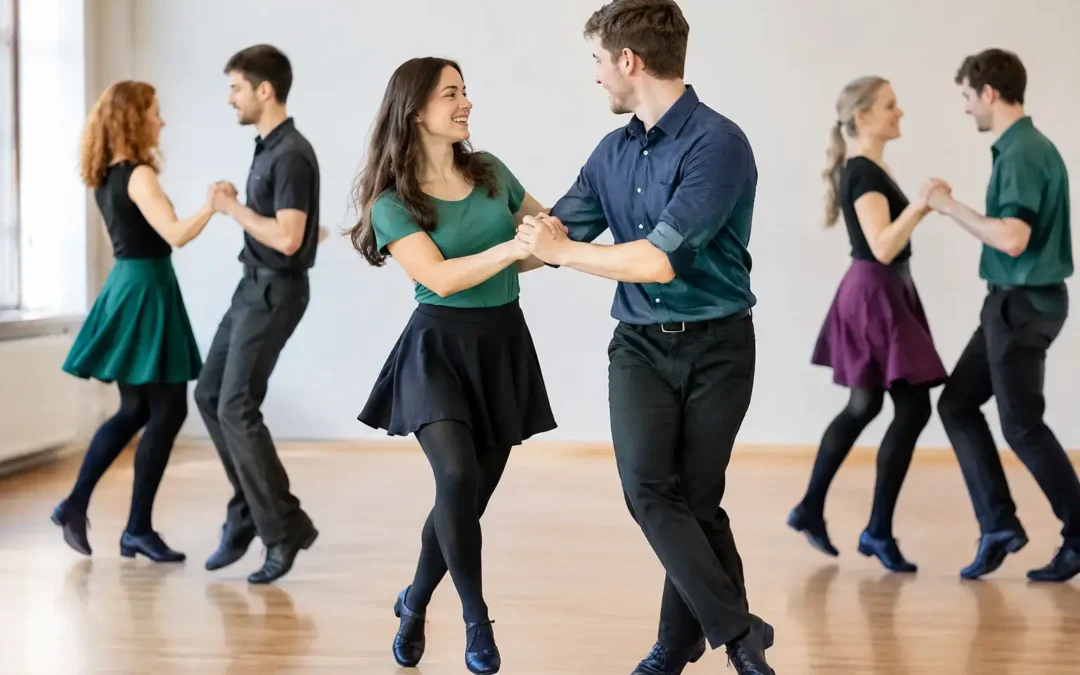
Picture a room full of people moving to lively Irish music, changing partners, laughing when they turn the wrong way, then finding the beat together. That is ceilí dancing explained in its simplest form: sociable Irish dance built around shared patterns, welcoming energy and the pleasure of joining in.
Unlike a solo performance, a ceilí is a group dance. You may dance in a circle, a line, a square or a set of four couples. The aim is not to look perfect from the first count. It is to listen, move with the group and enjoy the music. For children, teens and adults alike, it is a brilliant way to become active, build confidence and make friends without the pressure of dancing alone.
What is ceilí dancing?
The word ceilí, pronounced “kay-lee”, comes from the Irish word for a social gathering. A ceilí can describe both the event and the style of dance enjoyed there. Traditionally, people gathered in homes, community halls and village spaces for music, stories and dancing. Today, ceilí dancing remains a much-loved part of Irish culture, from family celebrations and school events to dedicated social dance classes.
The dances are made from repeating figures. A teacher or caller explains the sequence, counts dancers in and offers reminders as the music begins. You might take hands in a circle, skip around a partner, pass through the middle of a set or turn with the person beside you. Each dance has its own pattern, but the building blocks soon become familiar.
That shared structure is what makes it so accessible. Nobody needs to invent moves on the spot. Once you know where to be and when to move, you can relax into the music and enjoy the people around you.
Ceilí dancing explained through the basic formations
A formation simply means the shape dancers make together. Most beginners meet a few common ones early on, and each creates a different feel in the room.
A circle dance places everyone around the outside, often holding hands. It is especially friendly for younger children and complete beginners because the group can see and support one another. Circle dances are ideal for learning rhythm, direction and timing.
A longways dance has two lines facing each other. Partners or pairs travel up and down the set, meeting different people as they go. These dances feel lively and communal, because each pair takes a turn before returning to their place.
A four-hand reel uses four dancers in a small square. This is one of the best-known ceilí formations. Dancers move in a repeating pattern with their group of four, combining stepping, turning and changing places.
A set dance usually involves four couples arranged in a square. It can be more detailed, with several figures and a longer sequence. Sets are wonderfully social and rewarding, but they are often introduced after dancers feel secure with the basic footwork and etiquette.
The terminology may sound unfamiliar at first, yet beginners do not need to memorise it before class. A good teacher breaks every movement into manageable pieces, lets dancers walk it through without music, then gradually adds pace and confidence.
What happens in a beginner ceilí class?
A welcoming class starts well before the music speeds up. The teacher will introduce the group, explain the dance space and show everyone how to hold hands safely and respectfully. Dancers warm up first, preparing the ankles, knees and posture for movement.
Next comes the teaching. Rather than being expected to copy a full routine at once, beginners learn a short section, practise it slowly and repeat it with a partner or small group. The teacher calls the steps clearly and helps everyone recognise the musical count. There is usually plenty of smiling, a few missed turns and a great deal of encouragement.
As confidence grows, the group puts the figures together. The music gives the dance its lift, but the people in the room give it its character. You do not need a regular partner, expensive costume or previous dance experience. Comfortable clothes and footwear that allow safe movement are usually enough for a first session.
For younger dancers, ceilí work develops the useful habits that support other areas of Irish dance: listening, spatial awareness, rhythm, posture and working as part of a team. For adults, it offers a refreshingly social route back into movement. The focus is on learning and enjoyment, not on getting every step right immediately.
Why ceilí dancing is so good for confidence
Many parents want an activity that helps their child grow beyond technical skill. Ceilí dancing offers exactly that because every dancer has a role. One child may lead a line, another may remember the next figure, and everyone learns that the dance only works when people notice and support each other.
This develops confidence in a practical way. Children learn to make eye contact, take turns, recover after a mistake and keep going when the music carries on. They also experience the satisfaction of contributing to something bigger than their own individual performance. That can be particularly valuable for children who are unsure about joining a solo class straight away.
There are physical benefits too. Ceilí dancing improves coordination, balance, musicality and stamina while making exercise feel joyful rather than repetitive. Because the dances involve travelling, turning and responding quickly to others, minds stay active as well as bodies.
Adults often find the social benefit just as meaningful. Starting a new activity can feel daunting, particularly if you have not danced since school. In a ceilí, attention naturally shifts from worrying about yourself to helping the group complete the pattern. That sense of shared purpose makes first sessions far less intimidating.
Is ceilí dancing the same as Irish step dancing?
They belong to the same rich Irish dance tradition, but they are not the same thing. Irish step dancing is often performed individually or in choreographed teams, with close attention to precise footwork, turnout, rhythm and presentation. It can be danced in soft shoes or hard shoes, and dancers may progress towards performances and competitions.
Ceilí dancing is primarily social and group-based. The steps are generally less technically complex for beginners, although advanced dances can demand excellent timing, stamina and awareness. Instead of concentrating only on your own feet, you are also responding to partners, formations and the group’s flow.
The two styles work beautifully alongside one another. A child who enjoys the sparkle and challenge of step dancing can gain teamwork and musical confidence from ceilí. Someone who comes for the social atmosphere may later become curious about individual Irish dance training. There is no need to choose a final path before trying a class.
A few simple ceilí dance manners
Good ceilí etiquette is less about formality and more about making everyone feel comfortable. Listen when the teacher is explaining a figure, take hands gently, be aware of the space around you and offer a cheerful smile to new partners. If somebody loses their place, help them rejoin rather than drawing attention to the mistake.
It also helps to arrive ready to participate. Jewellery that could catch on hands or clothing is best left off, and long hair should be tied back. Bring water, wear something comfortable and let the teacher know about any injury or additional support needed. Small practical choices help everyone dance confidently and safely.
Who can try ceilí dancing?
Almost anyone can. Pre-school children can enjoy age-appropriate circle games and simple rhythms, while school-age dancers benefit from learning fuller formations and teamwork. Teenagers often enjoy the performance energy and friendship that comes with a shared dance. Adults can begin with no experience at all, including those returning to activity after many years.
The right starting point depends on age, confidence and goals. A child who dreams of displays or competitions may combine ceilí with structured Irish dance classes. An adult looking for a friendly weekly activity may prefer a dedicated beginner social dance course. Both routes have real value, and both begin with the same first step: being willing to have a go.
At Kane Irish Dance, beginner teaching is designed to make that first step feel clear and supported. Dancers are guided by experienced teachers, encouraged at their own pace and welcomed into a community where effort matters as much as achievement.
A ceilí is not about arriving with perfect timing. It is about hearing the music, taking a hand and discovering how much confidence can grow when a room moves together. If that sounds like your kind of fun, a trial class can be a lovely place to start.