
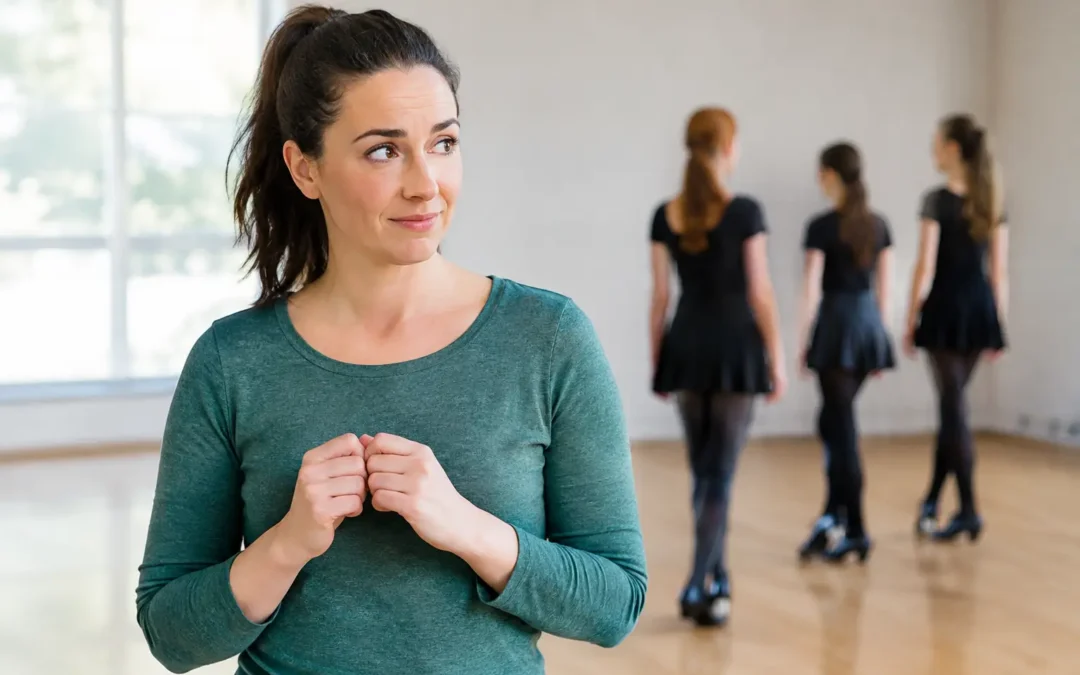
Walking into a dance class as an adult can feel far bigger than walking through a door. You may be wondering whether everyone else will know the steps, whether you need to be fit already, or whether you will look out of place in a room full of confident dancers. Adult dance anxiety is real, common and nothing to be embarrassed about. It is also something that can ease much sooner than you might expect when your first class is designed for beginners.
Irish dance offers a particularly rewarding place to start. It is lively, structured and sociable, with clear steps to learn and plenty of room to enjoy the music, have a laugh and improve at your own pace. You do not need childhood dance experience to take part. You only need a willingness to give yourself a first go.
Why adult dance anxiety feels so personal
Many adults have not learnt a new physical skill in years. At work, at home or with family, you may be used to being capable and in control. A beginner dance class asks you to be new at something, and that can feel exposing.
There can also be practical worries. Perhaps you think you are too old to begin, not flexible enough, not coordinated enough or not fit enough. Some people worry about getting the rhythm wrong. Others are concerned about attending alone, particularly if they have not joined a new group activity for a long time.
These thoughts do not mean dance is not for you. They usually mean you care about doing well. In a good adult beginner class, no one expects perfection in week one. The purpose of the class is to teach you, not to test whether you already know what to do.
The comparison trap
Adult dance anxiety often grows when we assume that other people are watching and judging. In reality, most beginners are concentrating hard on their own feet. They are trying to remember which foot starts, when to hop, and how to keep going when the music picks up.
It is also worth remembering that visible confidence is not always the same as genuine certainty. The person smiling beside you may have felt just as nervous before their first lesson. A welcoming class gives everyone permission to be learning together.
What a first Irish dance class is really like
A beginner Irish dance lesson is not a performance. You will be shown the foundations in manageable stages, rather than expected to copy a full routine immediately. Your teacher will demonstrate, break down the movement and give you time to practise.
Early lessons usually focus on posture, rhythm, basic footwork and simple travelling steps. You may work on movements individually, in small groups or all together. The pace should be encouraging but purposeful, allowing you to feel progress without being overwhelmed.
You do not need expensive kit to start. Comfortable clothing that lets you move freely is usually enough for a first session, along with suitable footwear as advised by the academy. Starting simply removes one more barrier and lets you focus on how the class feels.
Irish dance can be energetic, but fitness is built through participation. If you have an injury, a health condition or have been less active recently, let your teacher know before the class. They can help you make sensible adjustments. There is a difference between the healthy effort of learning a new skill and pushing through pain.
How to make adult dance anxiety more manageable
The aim is not to eliminate every nervous feeling before you attend. A little anticipation is normal. Instead, make the first step small enough that you can follow through.
Choose a true beginner course
A class labelled for adults is not always the same as one designed for adult beginners. Look for a course where no previous dance experience is assumed and where the teaching starts with the basics. This matters because adults learn best when they understand what they are doing, why it works and what a realistic next step looks like.
A structured course also means you are not arriving halfway through an established group and trying to catch up. You begin alongside others who are there for the same reason: to learn.
Give yourself a simple first-class goal
Do not make your goal “be good at Irish dance”. That puts too much pressure on one hour. A better goal could be to attend, learn one new step, introduce yourself to one person or leave feeling more comfortable than when you arrived.
Confidence is rarely a dramatic switch. It is built from small pieces of evidence: you found the venue, you joined in, you remembered a sequence, and you came back the following week.
Arrive a little early
Rushing through the door at the last moment can make nerves feel louder. Arriving ten minutes early gives you a chance to meet the teacher, ask any practical questions and settle into the space. Tell them honestly that you are feeling nervous. An experienced teacher will not find this unusual and can make sure you know where to stand and how the lesson will begin.
Let yourself be a beginner
Adults can be surprisingly hard on themselves. If a step does not click immediately, resist the urge to decide that you are uncoordinated or that everyone else is naturally better. Dance is learned through repetition. Your body needs time to connect the explanation, the music and the movement.
Being a beginner is not a permanent identity. It is simply the starting point for every dancer who has ever become confident.
Why Irish dance is especially good for adult beginners
Irish dance gives adults something more substantial than a workout, although it can certainly raise your heart rate. It combines concentration, movement and music in a way that takes you out of the day’s usual demands. For an hour, the focus is on rhythm, steps and the satisfaction of getting a sequence to flow.
There is also a strong social side. Ceilí-style social dance, for example, offers shared movement and partner changes without requiring you to arrive with a partner. It can be a lovely option for people who want the enjoyment of dancing with others but feel intimidated by formal couples’ dance.
For some adults, the appeal is cultural connection. For others, it is the chance to learn a style they have admired from a distance. And for many, it is simply enjoyable exercise with a clear sense of progress. The right reason is the one that makes you want to return.
The trade-off is that Irish dance asks for attention and practice, particularly as steps become quicker or more detailed. That is part of its appeal. You are not only attending a class, but developing a skill with real depth. A supportive academy should make that challenge feel motivating rather than exclusive.
Finding the right atmosphere matters
Not every class environment will suit every adult, and that is perfectly reasonable. Some people want a relaxed weekly hobby; others enjoy setting goals around performances or progressing to more advanced work. The best starting point is a class that respects both possibilities without pressuring you into either.
Look for teaching that is clear, encouraging and attentive to individual progress. You should feel able to ask questions, make mistakes and celebrate improvements. A class can hold high standards while still being warm. In fact, the clearest standards often make beginners feel safer because they know what they are working towards.
At Kane Irish Dance, adult beginner tuition is built around that balance: expert guidance, a friendly community and a meaningful sense of achievement. Whether you want a fresh way to stay active, a sociable evening or the pride of learning a new discipline, you deserve a start that feels welcoming.
Your confidence does not have to come first
Many people wait to book a class until they feel confident enough to attend. Usually, confidence arrives after attendance, not before it. The first lesson may feel unfamiliar. The second will feel less so. By the third, you may notice that you are listening less to your worries and more to the music.
Give yourself permission to take the smallest next step: enquire about a beginner course, arrange an induction or book a trial. You do not need to prove that you belong before you begin. Turning up is how you begin to belong.