
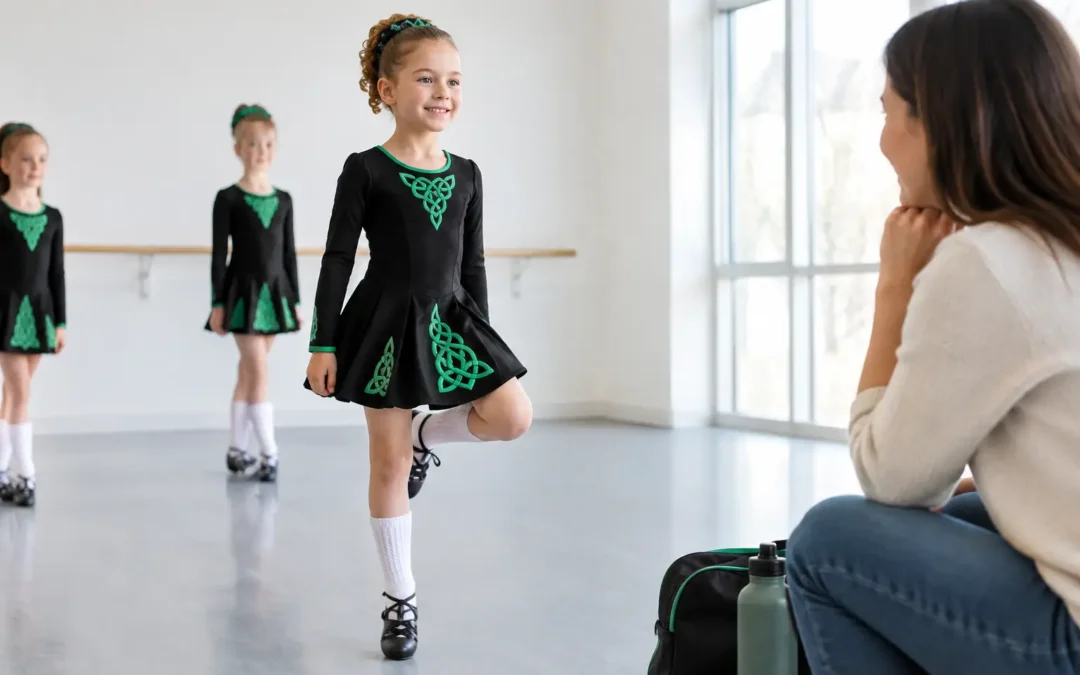
A child comes home tapping out a reel on the kitchen floor, asks to try Irish dancing, and the first question many parents rightly ask is: are Irish dance classes expensive? The honest answer is that they can become a meaningful investment, particularly for dancers who choose to compete, but starting lessons does not need to mean buying a full costume or committing to years of training straight away.
For many families, Irish dance offers far more than an after-school activity. It is a place to build confidence, fitness, focus and friendships, with clear goals to work towards. Understanding which costs come at the beginning, which are optional and which only arise as a dancer progresses makes it much easier to choose a class that feels right for your family.
Are Irish dance classes expensive for beginners?
Beginner Irish dance classes are usually comparable with other structured children’s activities such as gymnastics, martial arts or music tuition. The exact weekly cost varies by area, class length, teacher experience, venue and whether families book by the term, month or course.
The important distinction is between the cost of trying Irish dance and the cost of pursuing it at an advanced level. A well-run beginner programme should give a child time to learn the basics, settle into the group and decide whether they enjoy it before a family needs to make bigger purchases.
At Kane Irish Dance, trial classes and beginner entry points are designed to make those first steps approachable. Children do not need previous dance experience, and a good academy will explain what to wear and bring without expecting parents to arrive with specialist kit. Comfortable clothing that allows movement is generally enough for a first session, along with a willingness to have a go.
For adults, the principle is the same. A beginner course should feel welcoming rather than intimidating. You can learn the rhythm, posture and footwork in ordinary comfortable exercise clothing before deciding how regularly you would like to attend.
What do Irish dance lesson fees cover?
It is tempting to compare class fees only by the number on the timetable, but the quality and purpose of teaching matter. Irish dancing requires careful, progressive instruction. Dancers are learning timing, balance, musicality, coordination and technique, while also developing the discipline to practise and improve.
A reputable academy’s fees support more than time in a hall. They may reflect experienced teaching, safe class sizes, DBS-checked staff and volunteers, insurance, venue hire, music, lesson planning and a structured syllabus that gives dancers a genuine sense of progress. For children, that consistent encouragement can be just as valuable as the steps themselves.
Ask how the programme is organised. Is there a clear beginner group? Can dancers move into the next level when they are ready? Are there opportunities for displays, social dance or competitions, without pressure to take part in every option? Clear answers help families see what they are paying for and whether the class suits their goals.
Shoes: the first extra cost
Shoes are often the first purchase families think about, but they are not always needed on day one. Beginners commonly start in soft shoes once they have attended a few classes and know they would like to continue. These are lighter and less expensive than hard shoes, which create the distinctive percussive sounds associated with Irish dance.
Hard shoes are normally introduced later, when a dancer has developed enough control and strength. This staged approach matters. Buying expensive hard shoes too early is not only unnecessary, it can be less helpful for a child who is still learning the foundations.
Children’s feet grow quickly, so it is sensible to ask the teacher for fitting advice before purchasing. Second-hand options can sometimes be suitable for early stages, provided the shoes fit safely and are in good condition. A supportive academy will guide you towards what is genuinely needed now, rather than what may be needed much later.
Uniforms and costumes: not a beginner requirement
Irish dance costumes can look spectacular on stage and at competitions, which can make the activity appear costly from the outside. Yet beginner dancers do not need a competition dress or elaborate outfit to take part in weekly classes.
Many schools have a simple class uniform or branded clothing for performances, while some early displays may use a more affordable coordinated outfit. Competition costumes tend to become relevant only if a dancer chooses that pathway and reaches the appropriate level. They can be bought, hired, borrowed or commissioned, depending on the event and the family’s preference.
This is one area where plans vary greatly. A child who loves a weekly class and enjoys local displays may have very different costs from a dancer preparing for major championships. Neither route is better. The right route is the one that brings enjoyment, healthy challenge and a manageable commitment for your family.
When do competition costs begin?
Competition is an exciting goal for some dancers, but it is not the starting point and it is not compulsory. A strong programme builds confidence in class first, then offers performance and competitive opportunities when dancers are technically ready and genuinely interested.
When a family does choose competitions, costs can include entry fees, travel, accommodation for events further away, suitable footwear, costume arrangements and occasional extras such as hair accessories. These costs are usually spread over time rather than appearing all at once, because a dancer progresses gradually through levels.
It is worth having an open conversation with the teacher before entering the competition pathway. Ask which events are appropriate in the first year, how often dancers usually compete and what the likely commitments are. Good guidance helps parents avoid surprises and means a child’s ambitions can grow at a pace that works for everyone.
There is also a middle ground that many families enjoy. Displays at community events, school celebrations and academy showcases can give children the thrill of performing, applause and team pride without the regular travel and expense associated with competitive dancing. Ceilí and social Irish dance offer another joyful route, focused on connection, music and shared movement.
How to keep Irish dance affordable
The best way to manage costs is to take one stage at a time. Begin with a trial or introductory course, rather than assuming your child needs everything immediately. Once they are attending regularly and enjoying the experience, your teacher can advise on the next sensible purchase.
Before enrolling, ask whether fees are paid weekly, monthly or per term, whether there are membership or examination fees, and what items are optional at the beginner stage. It can also help to set a family budget for activities each term, including any shoes or events you may wish to plan for.
Avoid comparing your child’s journey with another dancer’s. One family may be preparing for a championship, while another is delighted that their child now walks into class independently, remembers a full dance or has found a lovely group of friends. Both are real achievements.
Looking at value, not just price
An Irish dance class is most worthwhile when a child feels known, encouraged and safely challenged. The right environment helps quieter children find their voice, energetic children direct their focus and determined dancers pursue ambitious goals with expert support.
That does not mean every class will be the right fit, or that the most expensive option is automatically the best. Look for teaching that is age-appropriate, expectations that are clearly explained and a warm culture where children can learn without fear of getting a step wrong. For adults, look for a class that makes starting feel possible, whatever your fitness level or previous experience.
The cost of Irish dance can grow alongside a dancer’s ambitions, but it should never feel like a barrier to taking the first step. Start simply, ask practical questions and give your child the chance to discover whether the music, movement and community feel like home. A trial class can be the beginning of a hobby they enjoy for a season – or a source of confidence and accomplishment they carry for years.