
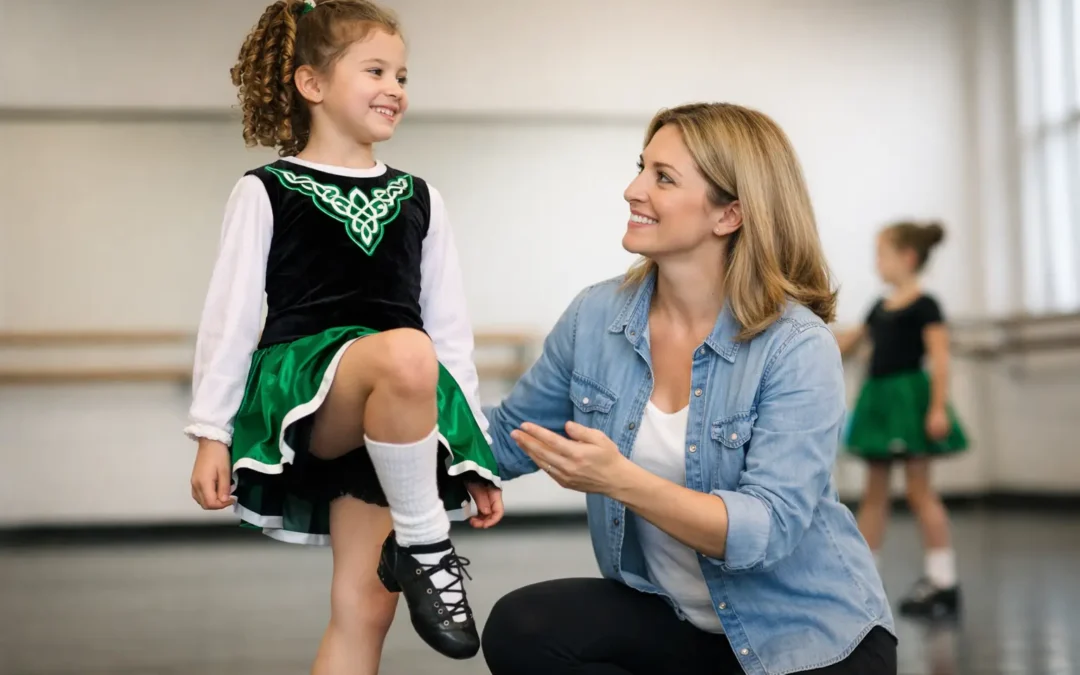
A child’s first Irish dance step often begins with a grin, a favourite piece of music and a little bit of stamping around the kitchen. When parents ask how to teach child Irish dance, that enthusiasm is a wonderful starting point. The aim is not to produce perfect technique at home straight away. It is to help your child feel the rhythm, enjoy moving and see themselves as someone who can learn something new.
Irish dance offers far more than a weekly activity. It gives children a focused way to use their energy, build coordination, make friends and work towards moments they can feel genuinely proud of – whether that is remembering a short routine, performing for family or stepping onto a stage.
Start with enjoyment, not correction
Young children learn best when dance feels like an invitation rather than a test. If they are very new, put on suitable Irish music and encourage them to march in time, clap the beat, skip, or copy simple shapes with their arms by their sides. Let them notice the quick, bright sound of Irish dance and respond naturally before introducing lots of instructions.
Posture matters in Irish dance, but it can be introduced gently. Ask your child to stand tall as though there is a string lifting the top of their head, keep their arms long by their sides and look ahead. Avoid asking them to hold a rigid position for too long. A relaxed child who enjoys practising will progress much further than one who feels worried about getting every detail right.
Praise should be specific. Instead of simply saying, “Well done”, try, “You kept going when that step felt tricky,” or, “I could really see you listening to the beat.” This helps children connect progress with effort, concentration and resilience – qualities that support them well beyond the dance floor.
Teach child Irish dance through simple foundations
A safe beginner session does not need to be long. For pre-school children, five to ten minutes of playful movement can be plenty. Children aged five and above may enjoy 15 to 20 minutes, particularly when practice includes music and a clear finish. Stop while they are still feeling positive rather than pushing until they are tired or frustrated.
Begin with a little space around them, comfortable clothing and secure footwear. Trainers are fine for early movement games, although they do not create the sound or feel of Irish dance shoes. Hard shoes should be fitted properly and used under guidance, especially on suitable flooring. Practising loud steps on a slippery kitchen floor, a raised surface or near furniture is not a good substitute for a dance studio.
You can introduce three helpful ideas: keeping time with the music, standing with good alignment and moving with control. Try marching for eight counts, then freezing tall and still. Follow this with gentle toe-pointing while holding onto a chair or an adult’s hand for balance. These small exercises help develop rhythm and body awareness without asking a child to attempt advanced steps too soon.
Keep the instructions short
Children can only hold so much information in their minds at once. Give one cue, allow them to try it, then offer the next. “Tall body” and “listen for the beat” are easier to act on than a long explanation of every part of the step.
Demonstration is equally valuable. Stand alongside your child rather than facing them at first, so they can copy the direction of your feet. If they turn the wrong way or lose the rhythm, keep the atmosphere light. Laugh together, reset and try again. Mistakes are part of learning choreography, even for experienced dancers.
Build a routine they can look forward to
Consistency is more useful than occasional, lengthy practice. A short practice once or twice a week can help a beginner remember what they have learned in class, while leaving plenty of room for rest, school, family life and other interests. For many children, a predictable time after tea or at the weekend works well.
Give each practice a beginning and an end. Start by choosing one piece of music or repeating a familiar movement. Finish with something they can already do confidently, such as their favourite march, skip or rhythm game. This creates a sense of achievement and makes them more likely to want to practise again.
It also helps to ask rather than assume. Some children enjoy showing their family every new step. Others prefer to practise quietly and share their dancing only when they feel ready. Performance confidence grows at different rates, and neither approach is wrong.
Know when a class makes the difference
A parent can create a brilliant introduction to Irish dance, but skilled teaching is what turns early interest into secure technique. Irish dance uses precise foot placement, posture, timing and turnout. These foundations need careful, age-appropriate guidance so children can develop safely and avoid habits that are difficult to change later.
A good beginner class also gives children something that home practice cannot fully recreate: a dance community. They learn to take turns, follow a group rhythm, encourage others and celebrate each dancer’s progress. For some children, walking into the room feels daunting at first. With a welcoming teacher and familiar faces, that nervousness can become a powerful source of confidence.
At Kane Irish Dance, beginners are taught in a supportive setting with clear progression from their first steps. Children can enjoy learning for fitness, friendship and performance, while those who wish to work towards displays, competitions and championship qualification have a credible path ahead. There is no need for a family to decide all of that at the first class. The right starting point is simply a place where a child feels safe, seen and excited to return.
Choose the right level for their age and personality
Pre-school dance should be playful, imaginative and centred on fundamental movement. For children aged five to 12, a more structured class can introduce routines, musicality and technique while still protecting the enjoyment that brought them there. Teenagers may value the social side, performance opportunities or the satisfying challenge of learning a new skill.
It depends on the child. A naturally energetic child may love quick-moving drills and lively music; a cautious beginner may need time to watch and copy before joining in. An experienced teacher will adapt the pace, offer encouragement and set achievable goals without lowering standards.
Support practice without putting on pressure
Parents have an important role, particularly in the first few months. Make sure your child gets to class on time, has water, wears the requested clothing and has a calm opportunity to practise any steps their teacher has set. Then let the teacher lead on technical corrections.
It is tempting to ask for a demonstration every time relatives visit or to compare progress with another child. Usually, this adds pressure where none is needed. Instead, focus conversations on how dancing made them feel. Did they enjoy the music? Did they make a friend? Which step are they pleased to have remembered?
If motivation dips, do not panic. Children can have off weeks after a busy time at school, illness or a difficult step. Keep communication open with their teacher and return to small, achievable practice goals. Long-term progress rarely looks like a straight line, but children learn a great deal when they discover they can stay with something and improve.
Celebrate the milestones that matter
A first full routine, a new pair of dance shoes, a class performance or the courage to enter a competition can all be meaningful milestones. So can quieter achievements: standing tall, listening carefully, trying again after a wobble or welcoming a new dancer into the group.
Irish dance gives children a rare combination of individual achievement and belonging. They are responsible for their own steps, yet they learn as part of a team that claps, practises and performs together. That balance can help a child grow in confidence without needing to be the loudest person in the room.
If your child is tapping their feet when the music starts, that is enough reason to begin. Give them time, encouragement and expert support, and those first happy steps may become a lasting source of pride.