
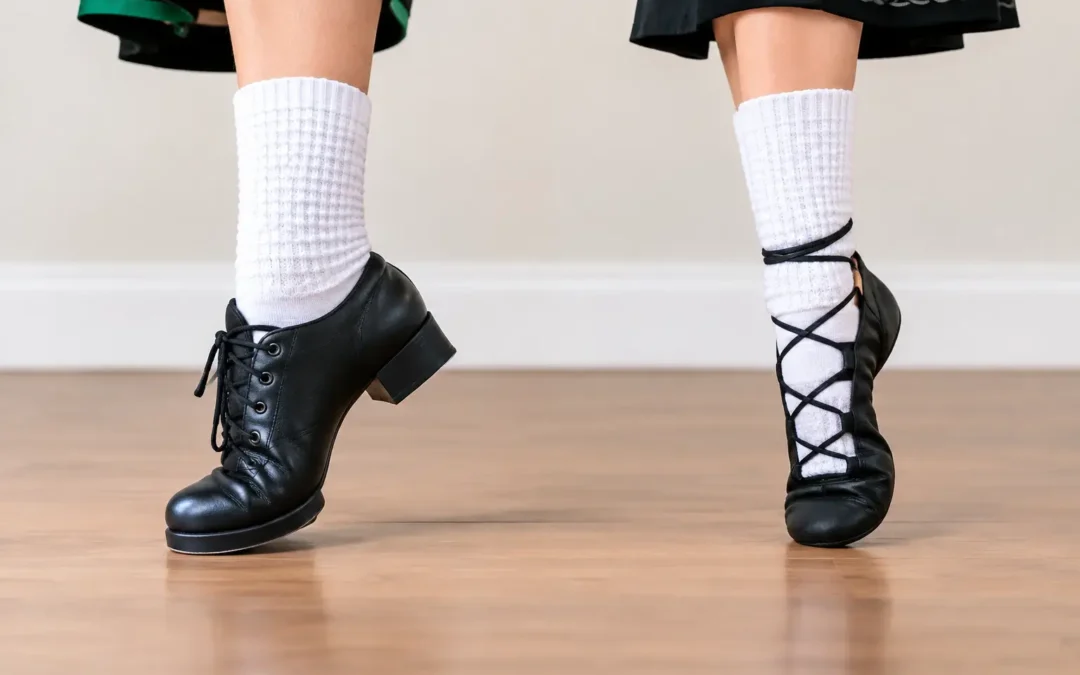
A child’s first Irish dance class often begins with a simple question from the car on the way home: “When do I get the noisy shoes?” Understanding hard shoes versus soft shoes helps parents and new dancers see that both are exciting parts of Irish dance, but they have very different jobs. One builds lightness, posture and flowing movement; the other brings rhythm, musicality and that unmistakable Irish dance sound.
At Kane Irish Dance, we want every dancer to enjoy the journey rather than feel they must rush to the next stage. The right shoe at the right time supports safe learning, growing confidence and technique that will serve them in class, on stage and, for those who choose it, in competition.
Hard shoes versus soft shoes: what is the difference?
Soft shoes are the first footwear most beginners meet in Irish dance. They are light leather shoes designed to sit closely around the foot, allowing dancers to point their toes, stretch through the ankle and feel the floor beneath them. Girls and women commonly wear laced ghillies, while boys and men may wear reel shoes with a heel.
Hard shoes are sturdier and have heel and toe tips that create sound against the dance floor. They are worn for traditional hard-shoe dances, where dancers make intricate rhythms with their feet as well as performing the steps. The sound is not simply a fun extra. It is part of the choreography, and learning to create it clearly takes control, timing and patience.
Neither type of shoe is “better”. They develop different qualities, and a well-rounded Irish dancer needs both.
What soft shoes teach
Soft-shoe dancing is where dancers develop many of the foundations that make Irish dance look effortless. The upper body stays tall and controlled while the feet move quickly and precisely beneath it. Dancers practise pointed toes, turnout, crossed feet, balance, lift and clean landings.
Soft shoes also encourage a lovely sense of flow. In reels, light jigs and slip jigs, the aim is not to stamp or force the movement. It is to travel with energy while appearing light on the feet. For young children especially, this is an enjoyable way to build coordination, listening skills and confidence in moving to music.
A beginner may start in comfortable footwear for an induction or trial class, depending on the teacher’s guidance. There is no need to buy expensive dance shoes before a child has had the chance to try Irish dance and decide whether they love it.
What hard shoes teach
Hard shoes introduce a new layer of learning. Dancers must still maintain the posture, pointed feet and clean technique developed in soft shoes, while adding precise beats and rhythms. A hard-shoe dancer is making music with their feet, so every sound needs to be intentional.
This is why hard shoes can feel wonderfully satisfying. When a group learns a rhythm together, the studio fills with energy. Dancers hear their own progress as well as seeing it. A step that once sounded muddled gradually becomes sharp, even and confident.
Hard shoes are also heavier than soft shoes, and they ask more from the feet and lower legs. This does not mean they are unsuitable for children. It means they should be introduced carefully, with age-appropriate teaching and enough technical preparation. Progressing too quickly can lead to habits that are difficult to correct later, such as banging the floor rather than striking it with control.
Which shoes should a beginner start with?
For most new dancers, soft shoes are the natural starting point. They allow a teacher to focus on body position, basic steps, rhythm and the foot strength needed for more advanced work. Children can enjoy learning dances and performing early routines without being overwhelmed by too much equipment or too many technical demands.
However, the exact pathway depends on the dancer’s age, programme and experience. A pre-school dancer may spend much of their class developing rhythm, coordination and enjoyment through imaginative, structured movement. A child joining at primary-school age may progress through beginner skills at a different pace. Teenagers and adults who begin later can often understand patterns and musical counts quickly, but still need time for their feet and ankles to adapt.
For this reason, there is no single date on the calendar when every dancer should receive hard shoes. Teachers look for readiness rather than comparing one child with another. A dancer may be ready when they can listen carefully, retain short sequences, work safely in their own space and demonstrate a reliable level of control in soft-shoe basics.
Parents sometimes worry that starting in soft shoes means a child is being held back. In reality, the opposite is usually true. Strong foundations make hard-shoe work more enjoyable when it arrives. The dancer has the balance to cope with the extra weight, the awareness to shape their sounds and the confidence to concentrate on a more detailed routine.
When is a dancer ready for hard shoes?
Readiness is about more than enthusiasm, although enthusiasm certainly helps. A teacher will consider technique, strength, concentration and how well the dancer responds to instruction. They will also consider the individual child. Some dancers are physically strong but need more time with rhythm; others are musically confident but need to build safer alignment through the ankles and knees.
A good progression into hard shoes feels motivating, not intimidating. The first lessons may focus on simple sounds, standing correctly, lifting the feet and understanding how to strike without excessive force. Dancers should not expect immediate volume or complicated rhythms. Clear sounds come from quality movement, not from hitting the floor as hard as possible.
For families with competitive ambitions, patience matters even more. Competition routines ask for stamina, accuracy, presentation and consistently clear rhythm under pressure. The best route towards championship-level dancing is built through careful daily habits, not by skipping the early stages.
Getting the right fit matters
Irish dance shoes should fit securely, but they should not cause pinching, numbness or ongoing pain. Soft shoes usually need a close fit because loose leather can make it harder for the dancer to point and control the foot. Hard shoes also need to feel stable, particularly around the heel, as a shoe that slips can affect confidence and technique.
Feet grow quickly, especially in younger dancers, so it is sensible to check fit regularly. Tell the teacher if a dancer is complaining about rubbing, struggling to tie their shoes securely or suddenly looking less settled in familiar steps. A small adjustment can make a meaningful difference.
Avoid choosing shoes simply because they are a size larger and may last longer. Oversized dance shoes can interfere with safe movement. Equally, second-hand shoes can be useful in some circumstances, but hard shoes in particular may have been shaped to another dancer’s feet or worn unevenly. Ask for guidance before purchasing.
How parents can support progress at home
Children do not need a hard floor and a full practice set-up at home to make progress. In fact, practising hard-shoe sounds on an unsuitable surface can damage floors, disturb neighbours and encourage dancers to focus on noise rather than technique. Follow the teacher’s advice about when and where to practise.
The most helpful support is often simple: make sure shoes are brought to class, laces are checked, hair and clothing allow comfortable movement, and your dancer arrives ready to listen. Celebrate effort as well as achievement. Learning a new skip, remembering a sequence or finding the courage to perform in front of the class are all real milestones.
If your child is eager for hard shoes, acknowledge that excitement while reinforcing the value of their current work. You might say, “Your soft-shoe steps are getting really strong. Your teacher will let us know when you are ready for the next challenge.” That message keeps progress positive and takes away the pressure to keep up with anyone else.
The sound comes later. The confidence starts now.
Hard shoes bring sparkle, rhythm and a real sense of occasion to Irish dance. Soft shoes bring grace, strength and the essential control behind every polished performance. Both give dancers opportunities to develop discipline, friendships and pride in what their bodies can learn.
Whether your child dreams of performing, competing or simply finding a weekly class where they feel they belong, start with the stage that suits them now. A welcoming trial class is a chance to ask questions, meet the teacher and let them take that first confident step in their own time.