
Imagine a farmhouse kitchen in Ireland, a fiddle playing nearby and a cleared patch of floor ready for dancing. A travelling dance master demonstrates a step. The pupils watch, listen, try it, and try again. There may be a few notes in a book, but the real lesson is happening in the room: from one pair of feet to another.
That’s one of the most fascinating things about traditional irish dance. Steps have travelled through generations not just on paper, but through memory, movement and the careful attention of dancers learning from a teacher.
A step you could carry with you
In many Irish step-dancing traditions, a “step” is organised around a musical phrase of eight bars. A dancer might learn a passage beginning with the right foot, then repeat or “double” it beginning with the left. The pattern gives a pupil a helpful framework: learn one sequence, understand its rhythm, then practise its other-foot counterpart.
It’s a neat idea, but not a universal rule for every dance or every local tradition. The details could vary. And knowing the names or counts of movements on a page wasn’t the same as knowing exactly how they should feel. A written prompt might remind a dancer what came next; demonstration showed the timing, weight and character that made it come alive.
The familiar “right foot and left foot” approach is still a lovely way to make a step feel balanced and memorable. In class, a pupil can focus on one side, then discover the same pattern anew when it’s time to change feet.

What went into the dance master’s copybook?
A copybook was more like a memory aid than a modern instruction manual. It might preserve a dance’s name, a figure, a sequence, a few movement terms or a cue about which foot led. It could help a dancer or teacher recall a piece of repertoire, but it couldn’t easily capture every detail of a live demonstration.
That is why written records and oral teaching belong together. The page could hold a clue; the teacher supplied the movement. The pupil watched, listened and practised until the pattern became part of their own dancing.
One remarkable example is the surviving record of Cork dance master James Moynihan. Notes from an interview with him in 1938 describe reel steps he said reached back to the mid-to-late 1800s. The Irish Traditional Music Archive’s account of the Moynihan Dance Manuscript shows how written descriptions can preserve precious details while also reminding us how much dance knowledge depends on demonstration and style.
Kitchens, flag floors and local variations
During the 18th and 19th centuries, travelling dancing masters brought lessons from one community to another. They might teach wherever there was room to gather: in a kitchen, a barn or on a flag floor. Pupils learned by watching the master, copying the movement and repeating it until the steps began to settle.
As steps travelled, they were not simply stamped out in identical form. A dance could be remembered and performed differently from village to village, or from one dancing master to another. Local dancers might favour a particular version, adjust a movement or add their own style. Those differences are part of the story, not mistakes in a single fixed original.
For more about the people who carried lessons through rural communities, take a look at our post on the dance masters and teachers of the Irish countryside. Their journeys help explain how a dance could be both rooted in tradition and full of local character.

From foot to foot, and pupil to pupil
The heart of that teaching method is wonderfully direct. A teacher shows a step; a pupil watches and tries. The teacher offers a cue, the pupil adjusts, and the sequence is practised again. Slowly, the movement moves from someone else’s demonstration into the dancer’s own memory.
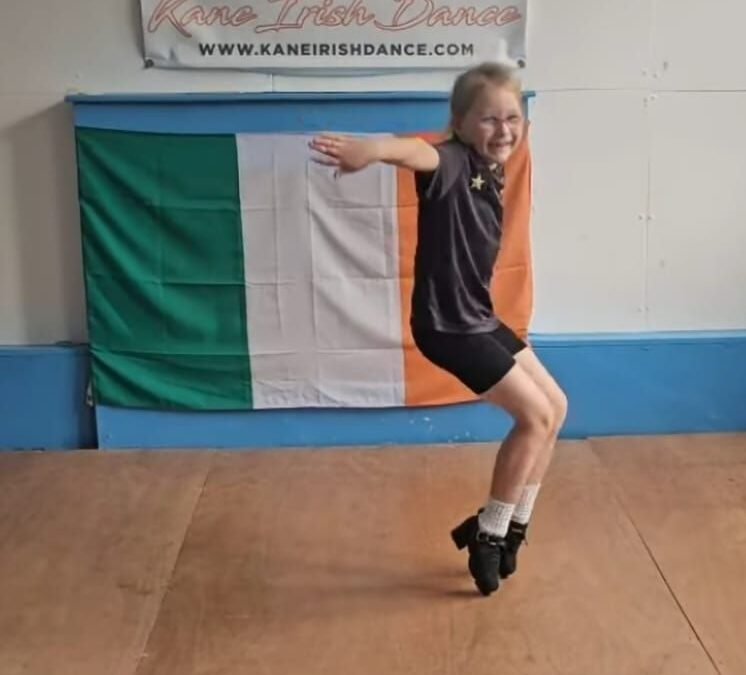
That process continues today at Kane Irish Dance in Huddersfield. Rebecca, the school’s owner and a World Champion, passes steps to pupils through demonstration, clear guidance and practice. A young dancer might begin by working through a short phrase, then gain confidence as the sequence becomes familiar on both feet.
If you’re wondering what those first steps actually look like, our beginner’s guide to how to learn Irish dance walks you through the journey from first class to first performance.
For children, this kind of learning is about more than remembering movements. It’s a chance to build focus, coordination and confidence, one small achievement at a time. Families exploring irish cultural activities can also discover how a living tradition connects communities across generations.

The tradition keeps moving
Today, a step may be taught in a Huddersfield studio rather than a farmhouse kitchen, but the essential exchange remains familiar: watch, listen, try, repeat. Copybooks and manuscripts help preserve traces of the past, while dancers and teachers keep the movement vibrant in the present.
If your child would like to learn irish dance, Rebecca and the Kane Irish Dance community would be delighted to welcome them. To arrange a free, non-obligatory 15-minute induction for new children, please contact Stephanie, our secretary, on 01484 958726.