
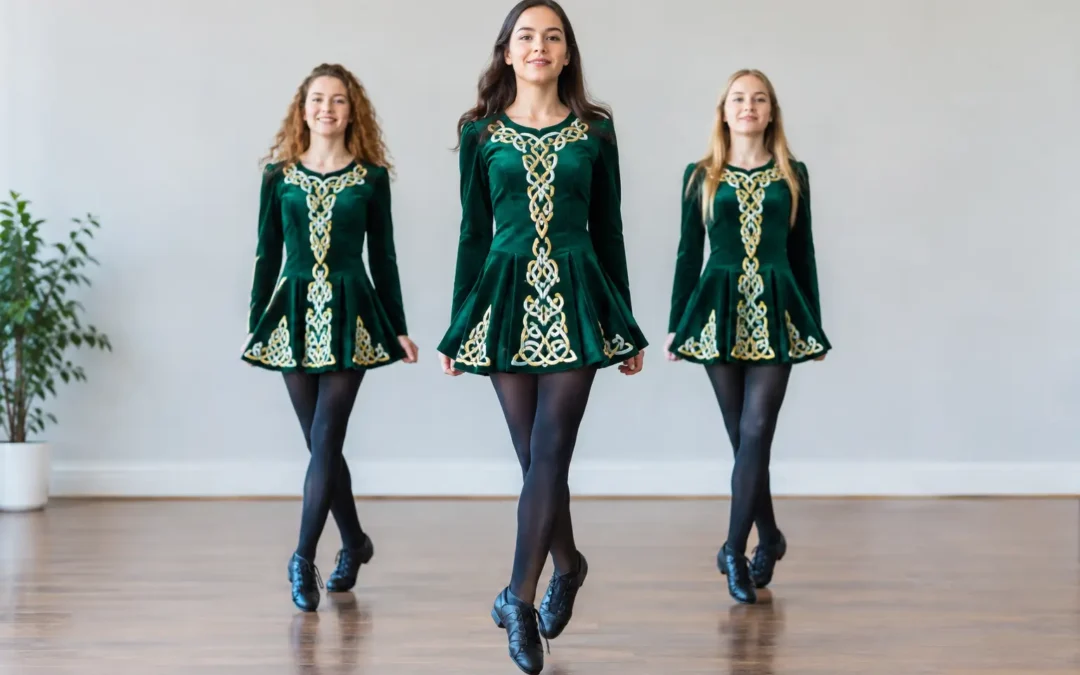
When a teacher calls, “Take your place for the reel,” a new dancer should not have to feel as though everyone else has been handed a secret handbook. This Irish dance terminology guide translates the words you will hear in class, at a display and, for some dancers, on the competition floor. Learning the language is not about sounding clever. It helps children listen with confidence, helps parents follow their progress, and makes the first lesson feel exciting rather than unfamiliar.
Irish dance has a wonderfully rich vocabulary, shaped by music, tradition and generations of teaching. Some terms can differ slightly between schools and dance organisations, so your teacher’s instruction will always be the one to follow. Think of these definitions as a friendly starting point.
Irish dance terminology guide: the shoes
The first distinction most families hear is between soft shoes and hard shoes. Both are an important part of a dancer’s development, but they create very different sounds and require different skills.
Soft shoes
Soft shoes are worn for dances where the focus is on lightness, rhythm, posture and graceful footwork. Girls and women commonly wear black lace-up shoes called pumps or ghillies. Boys and men may wear reel shoes, which are leather shoes with a heel and a flexible sole.
Soft shoe dancing includes the reel, light jig, single jig and slip jig. Not every dancer learns every dance immediately. Beginners usually build coordination, musical timing and good technique through age-appropriate steps before adding more complex material.
Hard shoes
Hard shoes have heel and toe tips that create the distinctive percussive sound many people associate with Irish dance. You may hear them called heavy shoes. They are used for dances such as the treble jig, hornpipe and set dance.
The sound is exciting, but hard shoe work is not simply about making noise. A good dancer develops control, clear rhythm and safe technique. At the right stage, hard shoes give dancers a new way to express the music, whether they are preparing a lively display routine or working towards competition.
Dances, tunes and steps
A reel is a fast, upbeat soft shoe dance, usually danced to music in a 4/4 rhythm. It is often one of the first dances beginners encounter because its energy makes it enjoyable to practise.
A light jig is also a soft shoe dance, traditionally danced in 6/8 time. It has a buoyant feel, while a single jig has its own distinctive rhythm and may be taught in beginner or recreational settings. The slip jig, also in 9/8 time, is known for its flowing quality and is traditionally danced by girls and women in many competition structures.
A treble jig is a hard shoe dance with a strong, powerful rhythm. A hornpipe is generally slower and more measured, giving dancers space to show precise beats and control. A set dance is a hard shoe dance performed to a particular traditional tune, with a set structure and character. In some contexts, dancers may refer to traditional set dances and contemporary choreographed set dances separately, so it is worth asking your teacher how the term is being used.
A step is a sequence of movements learned to a particular piece of music. A dancer may learn a beginner reel step, then progress to more demanding steps as their balance, stamina and timing improve. In a performance class, a routine may combine several steps into one polished piece.
You may also hear lead around, meaning the opening part of a dance that travels around the floor. The exact way this is taught varies. The key idea is that dancers are learning how to use space, stay in time and keep their place alongside others.
The movements teachers may call out
Irish dance teachers use short cues because dancers need to respond while moving. A hop is a small jump from one foot, while a jump lands on two feet or changes the dancer’s level more noticeably. A point stretches the foot with the toe placed neatly on the floor.
A cut is a quick crossing action of the feet, and a brush skims the foot along or close to the floor. In hard shoe work, you may hear references to heels, toes, clicks and trebles. These describe the sounds and actions a dancer creates with the shoes. The detail of each movement matters: clean technique protects growing bodies and makes the rhythm easier to hear.
Turnout describes the outward rotation of the legs and feet used in Irish dance. It should develop carefully, never be forced. Young dancers are guided to work within their natural range, building strength and placement over time. Strong posture, lifted legs, pointed feet and relaxed shoulders are all part of the picture, but progress looks different for every dancer.
Words used in class and at a ceilí
A solo dance is performed by an individual dancer, even when several dancers share the floor at once. It is the style most people picture when they think of competitive Irish dance.
A ceilí, pronounced “kay-lee”, is social Irish group dancing. Dancers work with partners or teams in set formations, following patterns that can involve circles, lines and changes of place. Ceilí is brilliant for building friendship, awareness of others and the confidence to join in. It is less about being centre stage and more about creating something together.
In class, a teacher may organise dancers into a line, a set or a round. A round usually means one turn of dancing before the next group takes its place. Drills are repeated exercises that help dancers practise a specific skill, such as timing, leg height or hard shoe rhythms.
A practice is the time a dancer spends repeating what they have learned between lessons. For children, short and regular practice is usually more useful than a long session once in a while. Parents do not need to become dance teachers at home. A little clear space, encouraging words and the chance to practise safely can make a real difference.
Competition language, explained simply
A feis, pronounced “fesh”, is an Irish dance competition. The plural is feiseanna, pronounced roughly “feh-sha-na”. Feiseanna can feel busy and exciting, with dancers performing in front of an adjudicator, the qualified judge who marks their dancing.
Competitions are usually divided into grades or levels. Names and rules depend on the dance organisation, but dancers commonly move through beginner, primary, intermediate and open championship levels. Advancement is earned through results and readiness, rather than rushed. A dancer who enjoys recreational classes and displays does not have to compete, while a dancer who has championship ambitions needs steady, focused training.
A recall means a dancer has been selected to dance again in a later round of a championship competition. A medal, trophy or placement recognises a result, but it is only one part of the experience. Preparing for a feis can also teach resilience, responsibility and how to perform under pressure with good sportsmanship.
You may hear experienced families talk about an Oireachtas, pronounced “o-rok-tas”. This word is used for major regional or national championship events in some organisations. World Championships, often shortened to “Worlds”, are a significant goal for advanced dancers who meet the relevant qualification requirements. These pathways are exciting, but the best next step always depends on a dancer’s age, enjoyment, commitment and confidence.
How to use these terms without feeling overwhelmed
New dancers do not need to memorise a dictionary before attending class. Children quickly absorb the words that matter to their next step, especially when teaching is clear and encouraging. Adults often find that asking one question at a time helps: Which shoes do I need now? What music are we using? Is this a solo dance or a ceilí?
For parents, it can help to focus on what you can see developing. Is your child listening more closely, remembering a sequence, making friends, standing taller or looking forward to class each week? Those small signs are meaningful achievements, whether their journey leads to a fun holiday club, a community display or the competition stage.
At Kane Irish Dance, beginners are taught the terminology alongside the movement, so nobody is expected to arrive already knowing the language. Bring curiosity, comfortable clothes and a willingness to have a go. The steps will make more sense with every class, and soon the words that once sounded unfamiliar will be part of a dancer’s own proud story.