
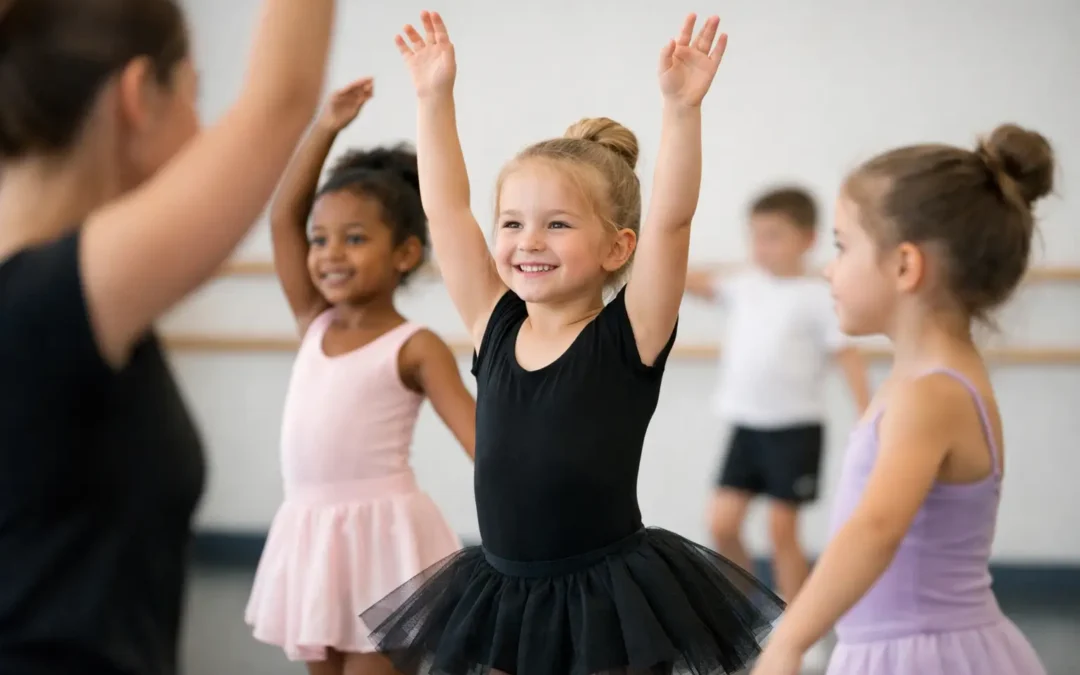
A child who knows the steps can still feel nervous when it is their turn to dance. They may watch the floor, copy the dancer beside them or go quiet when a teacher asks for a volunteer. The best dance confidence building activities make those moments feel safe, playful and achievable, so children learn that being seen is something to enjoy.
Confidence is not about making every child the loudest person in the room. It is the quiet certainty that they can have a go, recover from a mistake and keep moving forward. In Irish dance, that confidence grows through rhythm, posture, teamwork and the pride of recognising progress from one class to the next.
Start with a predictable class routine
For a nervous beginner, not knowing what happens next can be harder than learning a new step. A familiar opening routine gives dancers a secure place to begin. This might include lining up with their class group, a warm-up with the same key movements and a simple rhythm exercise everyone can join.
Predictability does not make classes dull. It gives children enough security to take positive risks later in the lesson. Once they know the room, the teacher and the rhythm of the class, they are more willing to step forward, ask a question or try a trickier sequence.
Parents can support this at home by keeping the journey to class calm and avoiding pressure to perform perfectly. A simple question such as, “What was one thing you enjoyed trying today?” usually builds more confidence than asking whether every step was right.
Use names, music and small wins
A dancer lights up when their effort is noticed properly. Teachers should use names often, celebrate concentration as well as technical success, and give feedback a child can act on straight away. “Your arms stayed beautifully still during that reel” is much more useful than a general “well done”.
Small wins matter because dance is built in layers. Learning to hold a strong dance position, keeping time for eight bars or remembering the next part of a routine are real achievements. When children can see those gains, they start to trust their own ability.
It is also worth being careful with praise. Constant, vague praise can feel empty, while comparison can make a child worry that there is only one way to succeed. Specific encouragement teaches dancers what they did well and what they can practise next.
The eight-count echo
One effective activity is an eight-count echo. The teacher claps or dances a short rhythm, then the class copies it together. Begin with movements every dancer can manage, then gradually add a new action, direction or change of speed.
Because the whole group responds at once, nobody is placed under a spotlight too early. Children develop musicality and listening skills, while the repeated success of matching the rhythm gives them a fast confidence boost. Older or more experienced dancers can lead a round when they are ready, which builds leadership without forcing it.
Make partnership feel supportive, not competitive
Irish dance can be individual in style, but it thrives on community. Partner activities help children realise that they are not being judged alone. They are part of a class that learns, laughs and improves together.
Try mirror dancing in pairs. One dancer performs a simple step or arm pattern while the other mirrors it, then they swap roles. For younger children, movements can be as straightforward as point, hop, turn and freeze. For teens, the exercise can include posture, foot placement and transitions between steps.
The goal is not to catch a partner out. It is to practise focus, cooperation and the confidence to lead for a short time. Pair children thoughtfully, especially in a new group. Two very shy dancers may need a friendly, patient partner nearby, while a confident dancer benefits from learning how to encourage someone else.
The encouragement circle
At the end of a session, gather the group briefly and invite dancers to share one positive thing they noticed. It could be a friend who kept trying, someone who remembered a new sequence or a group that worked brilliantly in time.
This activity works best when it is short and genuine. Children learn to recognise effort in others, and those who are quieter receive positive attention from their peers. It also helps create the kind of dance class families want: one where achievement is celebrated without anyone being left behind.
Give dancers a choice of challenge
Confidence does not grow when a task is far too easy, but it can disappear quickly when a dancer feels overwhelmed. Offering clear levels within an activity lets each child make progress at a pace that feels stretching but possible.
For example, during a travelling sequence, one dancer may focus on keeping the beat and finishing in the right place. Another may work on sharper turnout or cleaner elevation. A more advanced dancer may add speed, stamina or performance quality. Everyone is working on the same dance idea, but the personal target is different.
This approach is particularly valuable in mixed-experience groups and adult beginner classes. Adults can be nervous about looking inexperienced, while children may worry about being slower than friends. A well-taught class makes it normal to learn in stages.
Let performance begin in tiny steps
Performing in front of others can be a powerful confidence-builder, but it needs to be introduced with care. Asking a reluctant dancer to perform a full routine alone before they feel ready can have the opposite effect. Begin with low-pressure moments.
A dancer might first show one count with a partner, then lead a warm-up line, then dance with a small group facing the class. Later, they may be ready to perform a section in front of parents or take part in a display. Each stage proves that nerves can sit alongside success.
The celebration run-through
Instead of calling it a test, hold a celebration run-through at the end of a block of learning. The class dances a familiar routine for one another, with a clear focus such as strong posture, smiling faces or staying together in time. Afterwards, give every group a specific success to be proud of.
This is not a substitute for high standards. Good technique, disciplined practice and careful correction remain essential in Irish dance. The difference is that dancers learn to view feedback as part of their development, rather than proof that they are not good enough.
Help children learn how to handle mistakes
Even experienced dancers miss a beat, forget a transition or lose balance. What matters is the response. Teachers can model this by calmly restarting a phrase, smiling when something goes wrong and explaining that mistakes show where the next piece of learning is.
A useful activity is the “reset and repeat”. After a challenging section, allow the class to pause, take a breath and try again with one simple instruction in mind. Rather than replaying the error, dancers focus on the next action: listen for the music, lift through the body or finish the movement.
At home, families can reinforce this language. Replace “I can’t do it” with “I can’t do it yet”, then identify one small practice goal. Five focused minutes on a particular rhythm can be more helpful than repeating a whole dance until frustration takes over.
Create achievements children can see
Visible milestones give confidence somewhere to land. For a pre-school dancer, that may be joining the class independently or remembering a short action song. For a child learning Irish dance, it may be completing their first reel, earning a place in a display team or preparing for a first feis. Teenagers may take pride in stamina, technique and the responsibility of supporting younger dancers.
Progress charts, end-of-term acknowledgements and teacher feedback can all help, provided they celebrate individual development rather than rank children against one another. Competition can be a wonderful goal for dancers who want it, offering focus and memorable achievement. It should remain one pathway, not the only measure of a dancer’s worth.
At Kane Irish Dance, classes are designed to give beginners a welcoming first experience while providing a clear route towards performances, competitions and championship ambitions for those who wish to pursue them. That balance helps families choose an experience that fits their child, rather than expecting every dancer to follow the same path.
Build confidence beyond the dance floor
The benefits of a good dance class travel into school, friendships and family life. Children practise arriving prepared, listening carefully, working through challenges and supporting others. They discover that discipline and enjoyment can belong together.
For parents, the most encouraging sign is often not a perfect step. It is the child who walks into class more readily than they did a few weeks ago, volunteers to demonstrate a rhythm, or tells you about a friend they helped. Give that progress time. A confident dancer is not made in one big performance, but in many small moments when they feel safe enough to try again.